
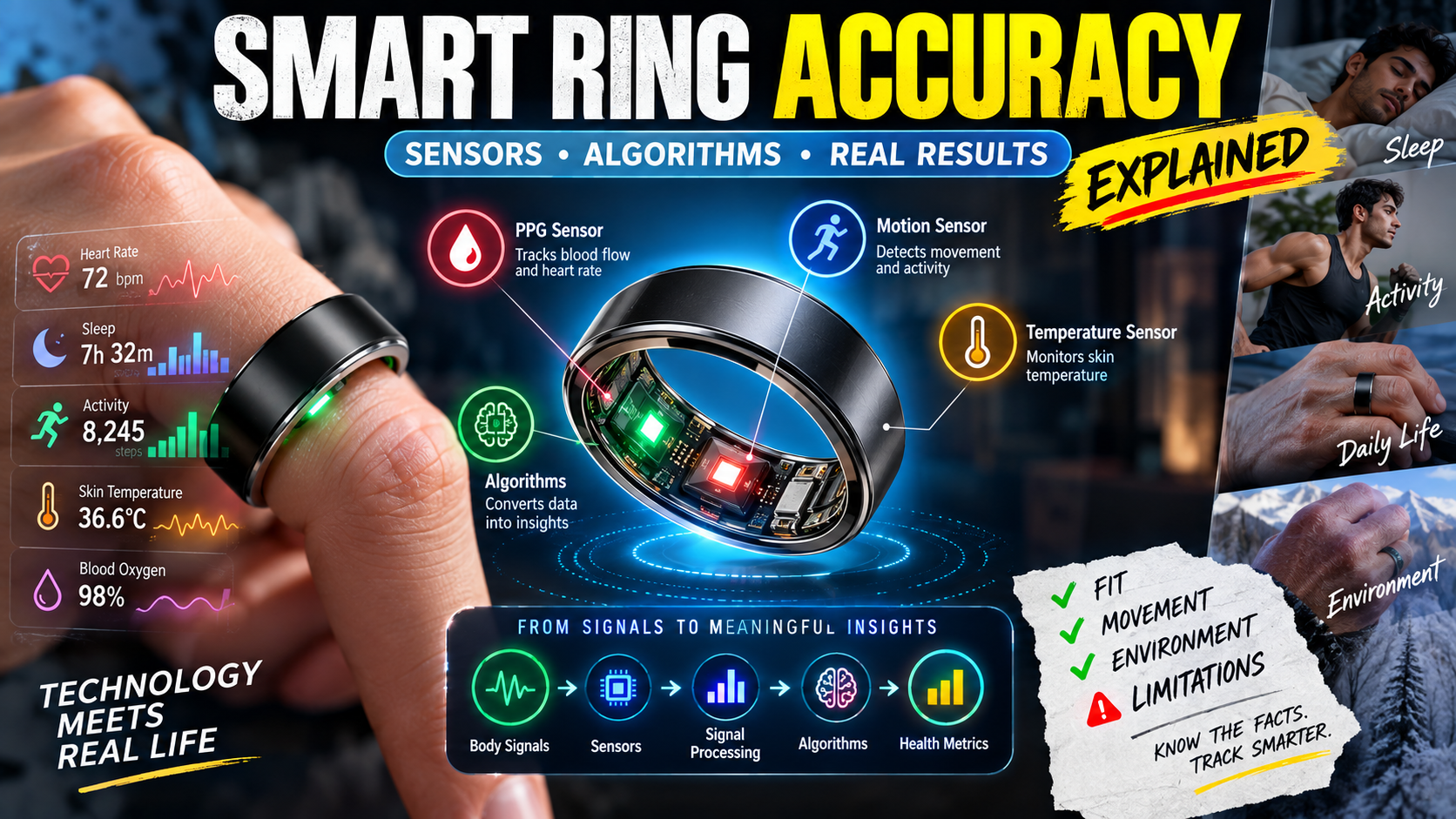
Smart Ring Accuracy Explained track heart rate, sleep, activity, temperature, and other health signals throughout the day. But the number shown in an app does not explain how it was measured or why it can change with movement, fit, temperature, or even the way you sleep. In this guide, we’ll explain how smart ring accuracy actually works, what affects it, which measurements have more uncertainty, and how to interpret your data more intelligently.
Key Takeaways
- Smart ring accuracy depends on the metric, device, measurement conditions, and validation method rather than one universal accuracy rating.
- Optical sensors, motion sensors, temperature sensors, and algorithms work together to convert physiological signals into reported smart-ring metrics.
- Movement, ring fit, skin contact, temperature, sweat, and circulation can affect the quality of wearable sensor signals.
- Some measurements are directly sensed while others are calculated or inferred from multiple signals, which can introduce additional uncertainty.
- Smart rings are most useful when their measurements are interpreted as consistent personal trends rather than isolated numbers.
- Consistent fit, clean sensors, appropriate wearing position, and following manufacturer instructions can improve measurement reliability.
- Smart-ring wellness data should not automatically be treated as equivalent to measurements from clinically validated medical equipment.
What Is Smart Ring Accuracy and How Is It Measured?
Smart ring accuracy is the degree to which a ring’s reported measurement agrees with an appropriate reference measurement for a specific metric and set of conditions. For example, researchers may compare a ring’s sleep measurements with polysomnography, or compare heart-rate readings with electrocardiography.
First, accuracy is not the same as consistency. A ring can produce very similar readings every night while still systematically estimating a metric differently from a laboratory reference.
For example, imagine a wearable consistently reports 7 hours and 45 minutes of sleep when a reference measurement records 7 hours and 30 minutes. The ring is producing a stable result, but the two measurements are not identical.
Moreover, there is no single accuracy percentage that applies to every smart ring or every health metric. Heart rate, sleep duration, sleep stages, blood oxygen, skin temperature, steps, and calories involve different sensors and different forms of algorithmic processing.
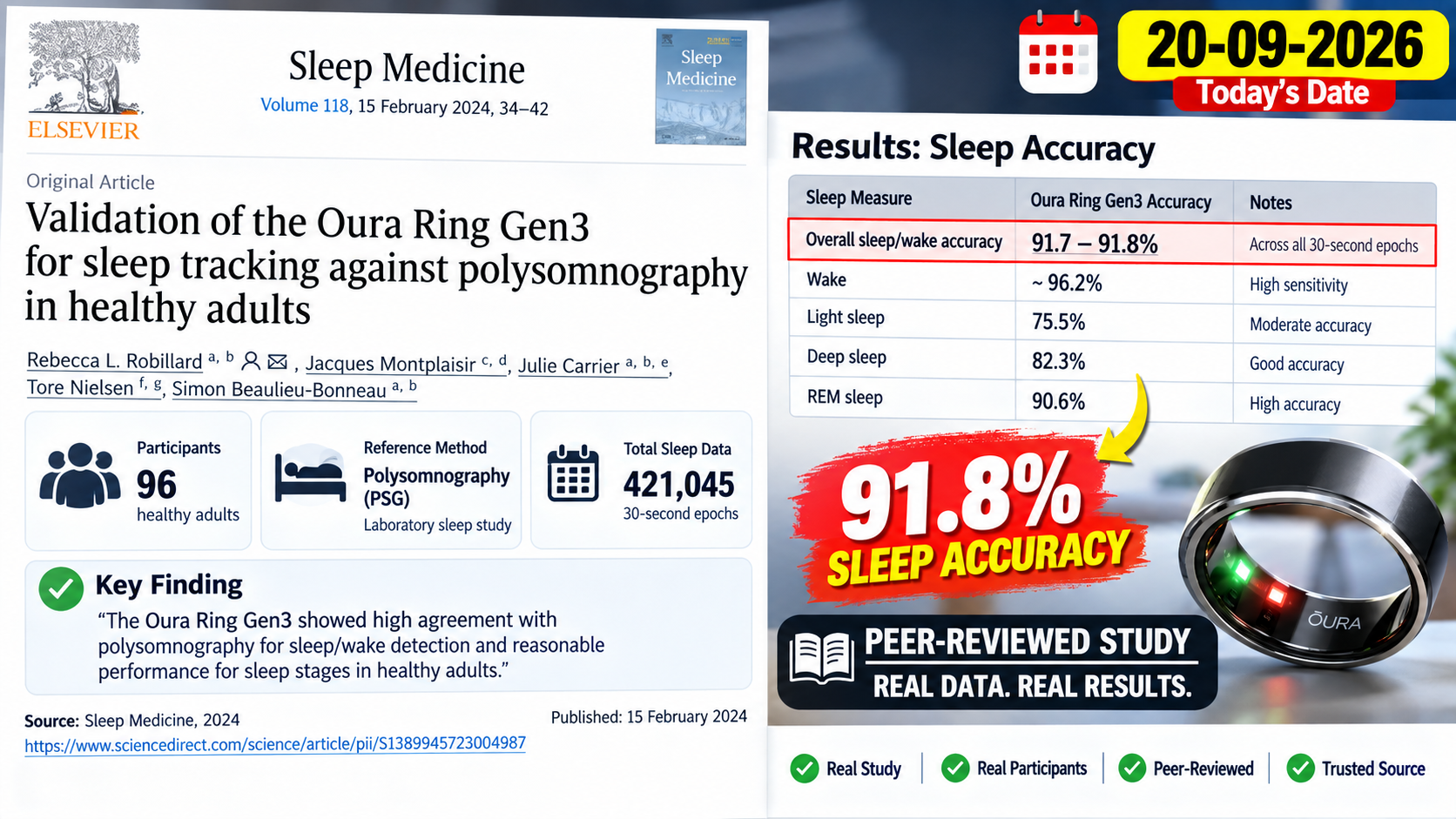
A 2024 validation study of the Oura Ring Gen3 compared it with polysomnography across 96 participants and 421,045 30-second sleep epochs. The study reported overall sleep/wake accuracy of about 91.7–91.8%, while sleep-stage accuracy varied by stage.
The important lesson is simple: always ask “accurate for what measurement, compared with what reference, and under what conditions?”
Accuracy, Precision, and Reliability Are Different
Accuracy describes closeness to a reference, while precision describes how consistently measurements cluster and reliability describes how dependably a system produces useful measurements.
For example, suppose you measure resting heart rate three times and receive 61, 62, and 61 beats per minute. Those measurements are tightly grouped, so they are consistent. Whether they are accurate depends on comparison with an appropriate reference.
At the same time, consumer wearables often become particularly useful when you observe your own measurements under consistent conditions. A small day-to-day change may be less important than a persistent trend over several weeks.
This is why smart-ring data should usually be interpreted as a combination of measurement and trend tracking, rather than as a collection of perfect laboratory values.
Why There Is No Universal Smart Ring Accuracy Score
A smart ring cannot be assigned one universal accuracy score because different metrics depend on different sensors, algorithms, body conditions, and reference standards.
For example, a ring may estimate sleep duration reasonably well while having more difficulty distinguishing individual sleep stages. A 2024 study comparing Oura Ring Gen3, Fitbit Sense 2, and Apple Watch Series 8 with polysomnography found sleep/wake sensitivity of at least 95% across the devices, while sleep-stage sensitivity varied substantially.
That distinction matters when reading product specifications or reviews. A statement such as “90% accurate” is incomplete unless it identifies what was measured and how accuracy was calculated.
Why Does Smart Ring Accuracy Matter for Health Tracking?
Smart ring accuracy matters because unreliable measurements can make trends harder to interpret and can create false confidence in individual readings.
First, wearable data can help you notice patterns that are difficult to recognize from memory. For example, consistently higher resting heart rate after several nights of poor sleep may provide useful context for your personal tracking.
Second, accuracy matters because different metrics have different levels of uncertainty. Sleep duration is not the same measurement problem as sleep-stage classification, and estimating calories is different again.
Research illustrates this distinction. A 2024 study involving five consumer sleep-tracking devices found that devices could estimate total sleep time reasonably well in many circumstances, while proportional biases appeared across different sleep-duration ranges and sleep stages.
Smart Rings Are Designed for More Than One Type of Measurement
Smart rings combine multiple physiological and movement signals to estimate different aspects of your daily activity and recovery.
For example, an optical sensor may collect pulse-related information while an accelerometer detects movement. The software can then combine those signals with other measurements to estimate sleep or activity.
That multi-sensor approach is one reason smart rings can provide more context than a single sensor alone. However, it also means that some final metrics are algorithmic estimates rather than direct measurements of a single physiological variable.
As such, a reader should distinguish between a sensor signal and the final number presented in an app.
Why Personal Trends Can Be More Useful Than Isolated Numbers
Consistent measurements collected under similar conditions can be useful for identifying personal trends even when individual readings are not clinically exact.
For example, comparing your resting heart rate at roughly the same time each morning can provide a more meaningful baseline than comparing readings taken immediately after exercise, during illness, and after waking.
This approach reduces some of the noise caused by changing conditions. It also makes the data easier to interpret because you are comparing similar situations.
How Do Smart Rings Measure Heart Rate and Other Health Metrics?
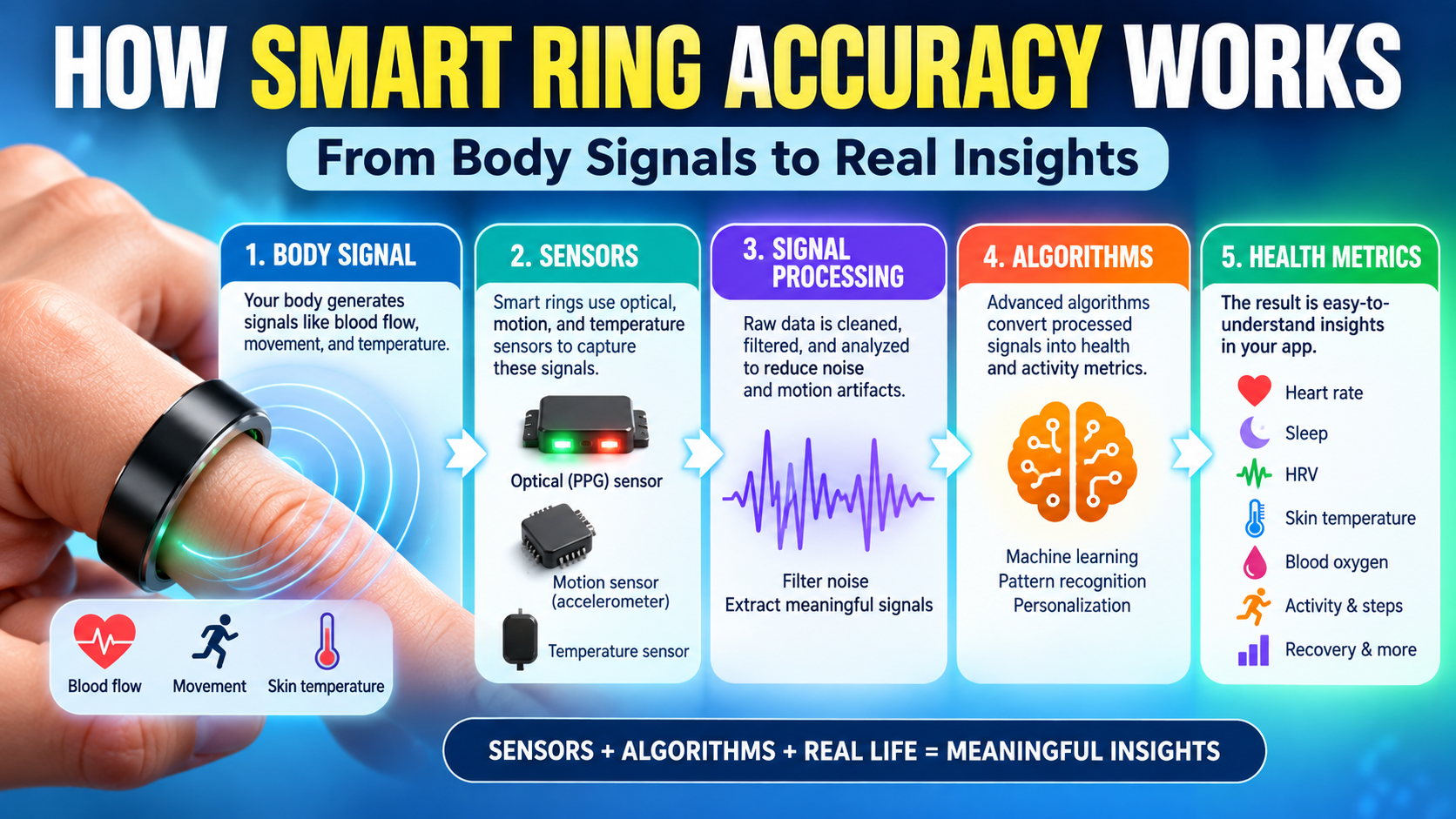
Smart rings use sensors such as optical PPG sensors, motion sensors, and temperature sensors to collect signals that algorithms process into estimated health and activity metrics.
First, the measurement process begins with physical signals from your body. Sensors collect those signals continuously or periodically depending on the device and metric.
Next, the device processes the raw sensor information. Software may remove noise, identify useful signal patterns, compensate for movement, and combine multiple data streams.
Finally, the algorithm converts processed signals into the metric displayed in the companion application.
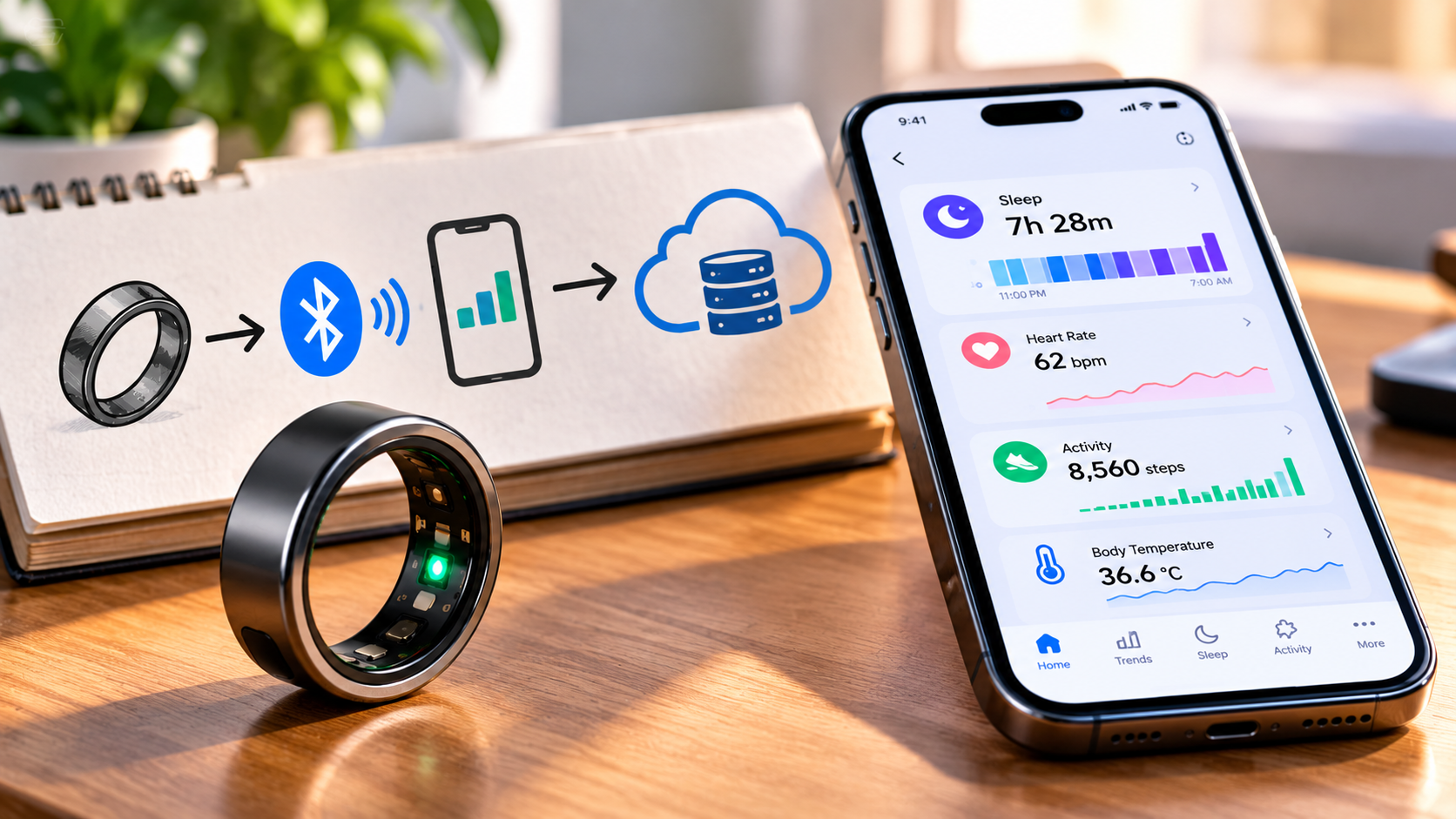
A useful simplified model is:
Body signal → Sensor → Raw data → Signal processing → Algorithm → Reported metric
How PPG Sensors Affect Smart Ring Accuracy
Photoplethysmography, or PPG, uses light and changes in reflected or absorbed light to detect blood-volume changes associated with the pulse.
For example, optical LEDs illuminate tissue while photodetectors capture changes in the returning light. The resulting signal can be processed to estimate pulse rate and related cardiovascular metrics.
However, PPG signals are sensitive to conditions around the sensor. Movement, contact quality, circulation, and other sources of optical noise can make the signal harder to interpret.
This is why sensor placement on a finger can be important for ring-based optical measurements. The finger provides a different measurement site from the wrist, but the signal still depends on stable contact and adequate signal quality.
How Motion Sensors Contribute to Smart Ring Measurements
Accelerometers and related motion sensors detect changes in movement that algorithms can use to estimate activity and support sleep classification.
For example, periods of relatively little movement during the night can provide one signal associated with sleep, while movement during the day can contribute to activity estimates.
Movement data becomes particularly useful when combined with physiological signals. Research on ring-based sleep algorithms has shown that adding autonomic and circadian features to accelerometer information can improve sleep-stage classification models compared with movement alone.
However, movement is not equivalent to sleep or wakefulness. A person can lie still while awake, and a person can move while asleep.
How Smart Rings Measure Skin Temperature
Smart-ring temperature sensors generally measure temperature-related changes at or near the skin rather than directly measuring core body temperature.
For example, a ring may detect that your finger temperature is higher or lower than your established baseline under similar conditions.
This can be useful for observing trends, but it should not automatically be interpreted as the same thing as a clinical core-temperature measurement.
Environmental temperature also matters. A cold room or cold hands can change the conditions at the sensor, which may influence the measurement.
How Do Smart Ring Algorithms Turn Sensor Data Into Health Metrics?
Smart ring algorithms transform noisy sensor signals into usable metrics by filtering data, identifying patterns, combining measurements, and estimating physiological states.
First, raw sensor data is rarely clean. Everyday movement, contact changes, electrical noise, environmental conditions, and physiological variation can all affect the signal.
Second, software can identify patterns that appear meaningful. For example, an algorithm may combine movement and cardiovascular signals to distinguish periods of likely sleep from periods of wakefulness.
Third, the algorithm produces a user-facing estimate. That estimate may look simple inside an app even though it is based on multiple layers of processing.
Signal Processing Helps Separate Useful Data From Noise
Signal processing reduces unwanted variation so algorithms can identify meaningful physiological patterns more reliably.
For example, a sensor may capture both a pulse-related optical signal and movement-related noise while you are walking. Processing techniques can attempt to separate the useful pulse pattern from the unwanted variation.
That does not mean processing eliminates every error. Instead, it means the software attempts to make the underlying signal more interpretable.
This distinction explains why better algorithms can improve the usefulness of similar hardware.
Algorithms Can Infer Metrics That Sensors Do Not Directly Measure
Some smart-ring metrics are algorithmic estimates based on multiple measurements rather than direct measurements from a single sensor.
For example, sleep stages cannot be directly observed by simply measuring movement with an accelerometer. Clinical sleep staging uses multiple physiological signals, including brain activity, eye movements, and muscle activity.
Consumer rings instead estimate sleep stages using combinations of available signals and trained algorithms.
A 2024 study of 96 participants found Oura Ring Gen3 sleep-stage accuracy ranging from 75.5% for light sleep to 90.6% for REM sleep under the study’s methodology.
These numbers should not be treated as universal performance figures for every smart ring. They illustrate a broader principle: different metrics can have different levels of measurement uncertainty.
How Do Movement, Ring Fit, and Environment Affect Smart Ring Accuracy?
Movement, fit, skin contact, temperature, sweat, and circulation can affect the quality of signals collected by smart-ring sensors.
First, movement can introduce artifacts into optical measurements. A ring that shifts while you exercise may experience changes in sensor contact at exactly the time your body is producing rapidly changing signals.
Second, fit determines how consistently the sensors interact with your skin. A ring that rotates or moves excessively can produce less stable contact than a properly fitted ring.
Third, environmental conditions can alter the measurement environment. Cold fingers, for example, can affect peripheral circulation and therefore the optical signal available to a sensor.
Does Ring Fit Affect Smart Ring Accuracy?
Ring fit affects measurement reliability because optical and other sensors depend on stable contact with the skin.
For example, a ring that is noticeably loose may rotate around your finger during normal activity. The sensor can therefore move relative to the tissue it is trying to measure.
At the same time, an excessively tight ring is not automatically better. The appropriate fit is the one recommended by the manufacturer that provides secure, comfortable contact without causing discomfort.
By maintaining a stable and manufacturer-recommended fit, you can reduce one common source of measurement variability.
How Does Movement Affect Smart Ring Sensor Readings?
Movement can create motion artifacts that make physiological signals harder for algorithms to interpret.
For example, a steady heart-rate signal is easier to isolate when the finger remains relatively stable than when the hand is rapidly moving during exercise.
This is why a heart-rate reading during intense activity may behave differently from a resting measurement. The physiological signal itself is changing while the sensor is also dealing with movement-related noise.
Moreover, movement can affect sleep estimation in the opposite direction. Being very still while awake can resemble sleep-like inactivity, while brief movements during sleep can complicate classification.
Can Cold Hands or Temperature Affect Smart Ring Accuracy?
Cold temperatures can affect optical measurements by changing peripheral blood flow and the conditions around the sensor.
For example, if your fingers are cold after spending time outdoors, the optical signal available at the measurement site may differ from the signal produced when your hands are warm.
The FDA notes that factors including poor circulation and skin temperature can affect pulse-oximeter readings, illustrating why optical oxygen measurements require careful interpretation.
This does not mean every smart-ring reading becomes inaccurate in cold conditions. It means measurement conditions matter, particularly for optical signals.
Can Sweat and Skin Contact Change Readings?
Sweat, moisture, skin contact, and sensor cleanliness can change the conditions under which wearable sensors operate.
For example, heavy exercise can change the interface between the sensor and skin while also creating substantial movement.
Keeping the sensor area clean and following the manufacturer’s wearing instructions can help maintain more consistent conditions.
How Accurate Are Smart Rings for Heart Rate, Sleep, HRV, and Blood Oxygen?
Smart-ring accuracy varies substantially by metric, with sleep duration, heart rate, sleep stages, HRV, blood oxygen, activity, and calorie estimates presenting different measurement challenges.
The table below provides a practical framework rather than a universal accuracy ranking.
| Metric | Typical measurement approach | Main accuracy challenges | Best interpretation |
|---|---|---|---|
| Heart rate | Optical PPG | Movement, contact, circulation | Trends and context |
| Resting heart rate | PPG during rest | Timing, physiological variation | Personal baseline |
| HRV | Pulse/beat-interval analysis | Motion, signal quality, algorithm | Long-term trends |
| Sleep duration | Movement + physiological signals | Quiet wakefulness, fragmented sleep | Overall sleep pattern |
| Sleep stages | Multi-signal algorithmic estimation | Stage classification complexity | Approximate trends |
| Blood oxygen | Optical oxygen estimation | Circulation, temperature, skin factors | Contextual wellness data |
| Skin temperature | Temperature sensor | Environment, sensor location | Personal trend |
| Steps | Motion sensors | Hand movement, device algorithms | Activity trend |
| Calories | Algorithmic estimate | Individual physiology and activity type | Broad estimate |
How Accurate Are Smart Rings for Heart Rate?
Heart-rate tracking can be useful for continuous personal monitoring, but its accuracy depends on signal quality, movement, fit, and the validation method used.
For example, heart rate measured while you are sitting quietly presents a different sensing challenge from heart rate measured while your hand is moving rapidly during exercise.
A 2022 validation study comparing several consumer wearables against electrocardiography found that wearable performance varied by device and measurement condition, reinforcing the importance of evaluating specific devices rather than treating all wearables as equivalent.
For everyday use, resting and overnight trends can therefore be easier to interpret than a single high-intensity exercise reading.
How Accurate Are Smart Rings for Sleep Tracking?
Smart rings can provide useful estimates of sleep duration and sleep timing, but sleep-stage estimates are more complex and should be treated as approximations.
For example, a 2024 study comparing Oura Ring Gen3 with polysomnography found strong agreement for several global sleep measures, while stage-level performance varied. The study included 96 participants and more than 421,000 30-second epochs.
A separate 2024 study of Oura Ring Gen3, Fitbit Sense 2, and Apple Watch Series 8 found sleep/wake sensitivity of at least 95%, but sleep-stage sensitivity ranged from 50% to 86% across the devices.
This difference is important because “the ring detected that you were asleep” and “the ring correctly identified your exact sleep stage” are different measurement tasks.
How Accurate Are Smart Rings for HRV?
Heart-rate variability is derived from variations between heartbeats, so HRV accuracy depends heavily on the quality of the underlying pulse signal and the measurement method.
For example, HRV measured during a stable overnight period may be easier to analyze than HRV collected during substantial movement.
The most useful approach is generally to compare HRV measurements using the same device, similar wearing conditions, and consistent time periods.
A sudden change in one reading does not automatically establish a physiological problem. Trends and context matter.
How Accurate Are Smart Rings for Blood Oxygen?
Blood oxygen estimation uses optical techniques but can be affected by circulation, temperature, skin-related factors, sensor positioning, and other conditions.
For example, the FDA identifies poor circulation, skin pigmentation, skin thickness, skin temperature, tobacco use, and nail polish among factors that can affect pulse-oximeter readings.
Smart-ring oxygen features should therefore be treated according to the specific device’s intended use and regulatory status. A wellness-oriented measurement should not automatically be treated as a clinically validated diagnostic result.
Why Can Smart Ring Readings Differ From a Smartwatch or Medical Device?
Smart ring readings can differ from watches and medical devices because the devices use different sensor locations, hardware, algorithms, sampling methods, and reference standards.
First, a ring measures from the finger while a smartwatch generally measures from the wrist. The two locations can produce different optical signals.
Second, manufacturers may process similar sensor data differently. One algorithm may smooth a signal more aggressively, while another may respond differently to motion or missing data.
Third, medical equipment may use different sensing methods entirely. For example, electrocardiography measures electrical cardiac activity, while PPG detects optical changes associated with blood-volume variation.
Why Different Devices Can Produce Different Sleep Results
Different sleep trackers can report different sleep durations or sleep stages because each device uses its own sensors, algorithms, and classification thresholds.
For example, a 2025 clinical-context study of three commercial ring trackers found that group-level sleep measures could appear reasonably similar to polysomnography while individual-level differences remained substantial. Across all sleep stages, classification accuracy varied considerably among the tested rings.
This demonstrates why agreement at the group level does not guarantee identical measurements for every individual.
Why Medical Devices Should Not Automatically Be Used as a Perfect Benchmark
A medical reference device is appropriate only when it measures the same physiological construct under a suitable validation protocol.
For example, ECG and PPG are related to heart activity but do not measure it in exactly the same way.
Similarly, polysomnography provides a much richer physiological record than a consumer ring. PSG can incorporate brain activity, eye movements, muscle activity, respiratory signals, and other measurements.
As a result, comparing a consumer metric with a clinical reference requires careful interpretation rather than simply asking whether the two numbers match.
What Are the Main Limitations of Smart Ring Accuracy?
Smart-ring accuracy is limited by sensor noise, individual physiology, fit, environmental conditions, algorithmic estimation, device differences, and the limitations of validation studies.
First, laboratory studies often involve controlled conditions that are different from everyday life. Real users move, change sleeping positions, experience temperature changes, and wear rings differently.
Second, individual differences matter. A model validated in healthy adults may not perform identically in people with different physiological characteristics or medical conditions.
Third, algorithms can change. Firmware and software updates may alter how raw signals are processed or how metrics are presented.
Laboratory Accuracy Does Not Guarantee Identical Everyday Performance
A device can perform well in a controlled study while producing more variable measurements in everyday environments.
For example, a sleep laboratory controls many conditions, while home sleep includes changing room temperatures, different bedding, irregular schedules, and normal nighttime movement.
A 2025 study involving people with sleep-related and other medical conditions found that individual-level discrepancies between commercial ring trackers and polysomnography could remain large even when group-level measures appeared similar.
This is why validation evidence should be interpreted according to the population, environment, sample size, reference method, and metric tested.
Consumer Wellness Data Is Not Automatically Medical Diagnosis
Smart-ring wellness measurements should not automatically be interpreted as clinical diagnoses.
For example, a low overnight oxygen estimate may be affected by measurement conditions, while an unusual heart-rate pattern may have multiple possible explanations.
The FDA specifically advises consumers not to rely only on pulse-oximeter readings when concerned about their health and notes that pulse oximetry has known limitations.
If a reading is persistently unusual or accompanied by concerning symptoms, use an appropriate validated measurement method and seek qualified medical advice rather than treating the ring’s number as a diagnosis.
How Can You Improve the Accuracy of Smart Ring Measurements?
You can improve measurement consistency by using the recommended fit, maintaining clean sensor contact, wearing the ring consistently, and interpreting readings under comparable conditions.
First, start with fit. The ring should remain secure without excessive movement and should follow the manufacturer’s sizing and wearing recommendations.
Second, keep the sensor area clean. Dirt, residue, or other changes at the sensor-to-skin interface can introduce unnecessary variability.
Third, establish consistent measurement conditions whenever possible.
A practical routine is:
- Wear the ring consistently according to manufacturer instructions.
- Use the recommended finger and orientation when the manufacturer specifies them.
- Maintain a secure but comfortable fit.
- Clean the sensors regularly.
- Compare similar time periods, such as overnight resting measurements.
- Look for multi-day or multi-week trends rather than reacting to one unusual value.
- Consider environmental conditions when a reading changes unexpectedly.
- Cross-check important measurements with an appropriate validated device when necessary.
Build a Personal Baseline
A personal baseline gives smart-ring measurements context because your normal range can be more informative than an isolated number.
For example, recording your typical overnight resting heart rate for several weeks creates a reference point for interpreting future changes.
The same principle can apply to HRV, skin temperature, sleep duration, and activity.
By comparing measurements collected under similar circumstances, you can reduce some of the confusion caused by normal daily variability.
Treat Trends as Data, Not Diagnoses
Smart-ring trends can provide useful context, but they should not be treated as standalone medical conclusions.
For example, several nights of changed sleep duration may tell you that your sleep pattern has shifted. That observation is different from diagnosing the reason for the change.
This distinction keeps wearable data useful without giving it more authority than the underlying measurement supports.
Which Tools and Practical Methods Can Help You Evaluate Smart Ring Accuracy?
The most useful accuracy-evaluation tools are independent validation studies, manufacturer documentation, appropriate reference devices, and consistent personal tracking.
First, look for peer-reviewed validation studies rather than relying only on marketing specifications.
Second, check what reference method the study used. For sleep, polysomnography is commonly used as a laboratory reference. For heart-rate validation, ECG is an important reference method.
Third, check the study population. A study involving healthy young adults does not necessarily establish performance in every population.
What Should You Look for in a Smart Ring Accuracy Study?
A useful validation study identifies the device, metric, reference method, participants, measurement conditions, and statistical method used to evaluate agreement.
For example, the 2024 Oura Gen3 sleep validation study clearly reported 96 participants, 421,045 30-second epochs, polysomnography as the comparison method, and separate results for global sleep measures and sleep stages.
That level of detail makes a study more informative than a vague claim that a wearable is “highly accurate.”
Free and Independent Resources
Peer-reviewed research databases such as PubMed provide a useful starting point for checking wearable validation evidence.
For example, you can search PubMed for a specific ring model plus terms such as validation, polysomnography, heart rate, or HRV.
You can also review manufacturer documentation to understand intended use and measurement limitations.
What’s Next for Smart Ring Accuracy and Health Tracking?
The next step is to evaluate smart-ring data metric by metric and build a consistent personal tracking routine rather than searching for one universal accuracy number.
First, identify which measurements actually matter to you. If your goal is sleep tracking, investigate sleep validation. If your goal is heart-rate monitoring, examine heart-rate validation.
Second, establish your baseline before interpreting changes.
Third, investigate persistent or unusual readings using appropriate reference methods rather than assuming the ring has identified a medical condition.
The broader direction of wearable technology is toward multi-sensor measurement and increasingly sophisticated algorithms. More sensors can provide additional information, but additional data does not automatically mean perfect accuracy.
A recent systematic review and meta-analysis of wearable sleep-tracking technologies found that wearables can provide reasonable estimates of global sleep metrics, while substantial variability between devices limits their use as standalone diagnostic tools or for detailed sleep-stage characterization.
Smart Ring Accuracy Explained:- A Simple Accuracy Checklist
A five-question accuracy checklist can help you judge almost any smart-ring measurement.
Ask:
- What exactly is being measured?
- Which sensor or sensors collect the underlying signal?
- Is the final value directly measured or algorithmically estimated?
- What reference method was used to validate it?
- Do the study conditions resemble how I actually use the ring?
For example, a sleep-stage percentage validated in a controlled laboratory study should not automatically be interpreted as a precise measurement of every night at home.
This checklist turns the vague question “Are smart rings accurate?” into a much more useful question: “How reliable is this particular metric under these particular conditions?”
Conclusion
Smart ring accuracy depends on the entire measurement system rather than the sensor alone. The sensor collects a physical signal, signal processing attempts to reduce noise, algorithms interpret the data, and the app turns those calculations into the metric you see.
Moreover, movement, fit, skin contact, temperature, circulation, environment, and individual physiology can all influence measurements. Sleep duration, heart rate, HRV, blood oxygen, skin temperature, steps, calories, and sleep stages also have different measurement challenges.
The strongest way to use a smart ring is to understand what its numbers represent. Look at consistent trends, compare similar conditions, check independent validation evidence, and avoid treating wellness estimates as automatic medical diagnoses.
Ultimately, you do not need every smart-ring number to be laboratory-perfect for wearable data to be useful. You need to understand what the measurement can tell you, what it cannot tell you, and how confidently you should interpret it.




1 thought on “Smart Ring Accuracy Explained 2026: The Definitive Guide to Sensors, Algorithms, Fit, and Limitations”