
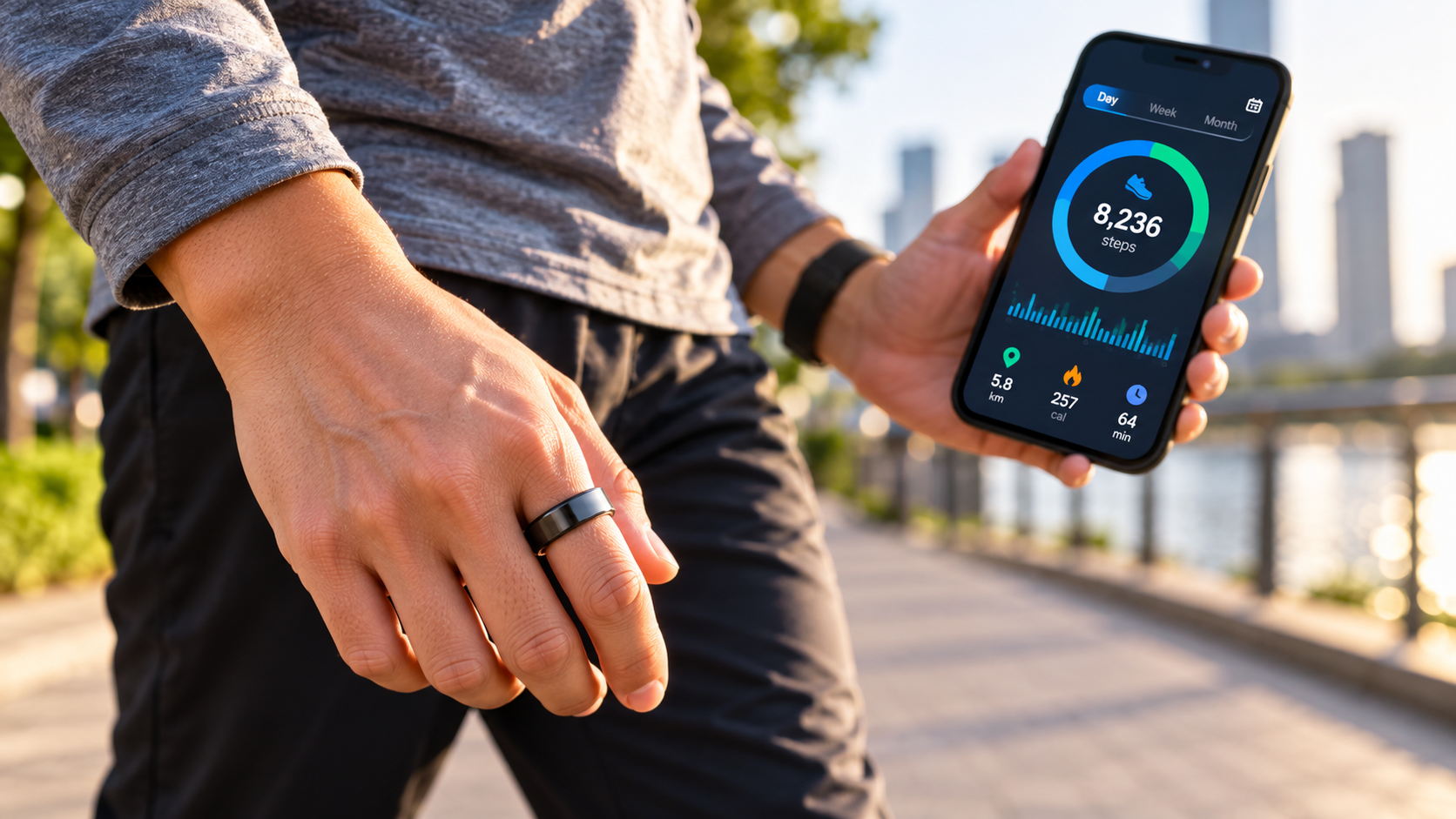
How can a tiny ring on your finger know that you just walked 2,000 steps? It cannot see your feet, hear your footsteps, or physically watch what you’re doing. Instead, how smart rings track activity comes down to a surprisingly sophisticated combination of motion sensors, signal processing and algorithms that turn tiny changes in movement into recognizable patterns.
That distinction matters. A smart ring doesn’t simply detect movement and add one to a counter. It collects sensor data, processes that data and tries to determine what the movement represents. Walking, running, washing dishes and pushing a shopping cart can all produce movement, but they don’t produce exactly the same patterns.
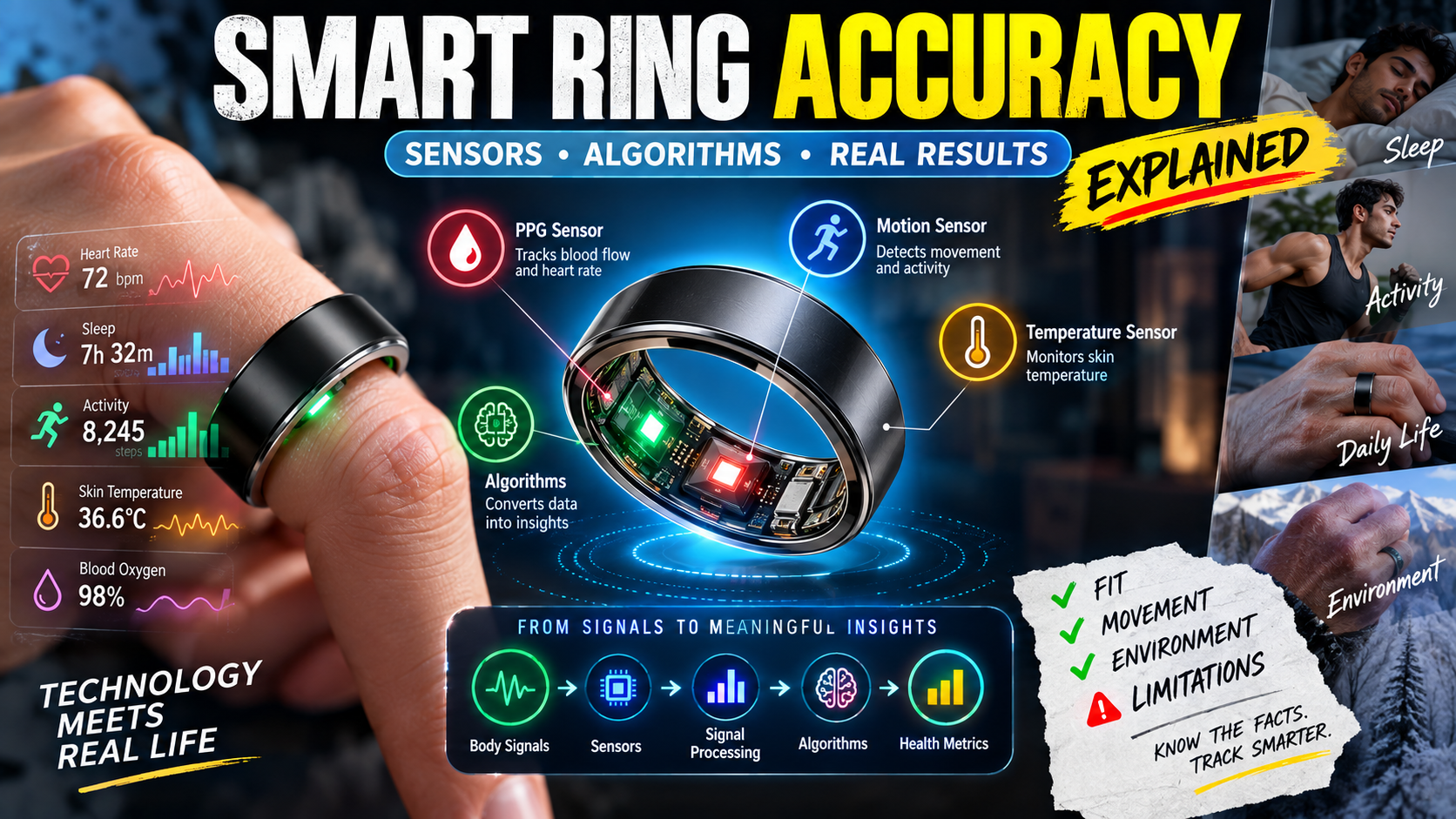
And there is another important detail: not every smart ring uses exactly the same sensors or algorithms. Samsung’s Galaxy Ring, for example, officially lists an accelerometer, optical heart-rate sensor and temperature sensor, while Oura documents a 3D accelerometer for activity tracking. A gyroscope is useful in wearable motion sensing, but it should not be assumed to be present in every smart ring.
The short answer: how does a smart ring know you’re moving?
A smart ring uses motion sensors to capture changes in movement and then applies software algorithms to interpret those signals. The result can be an estimate of steps, activity duration, exercise and other movement-related metrics.
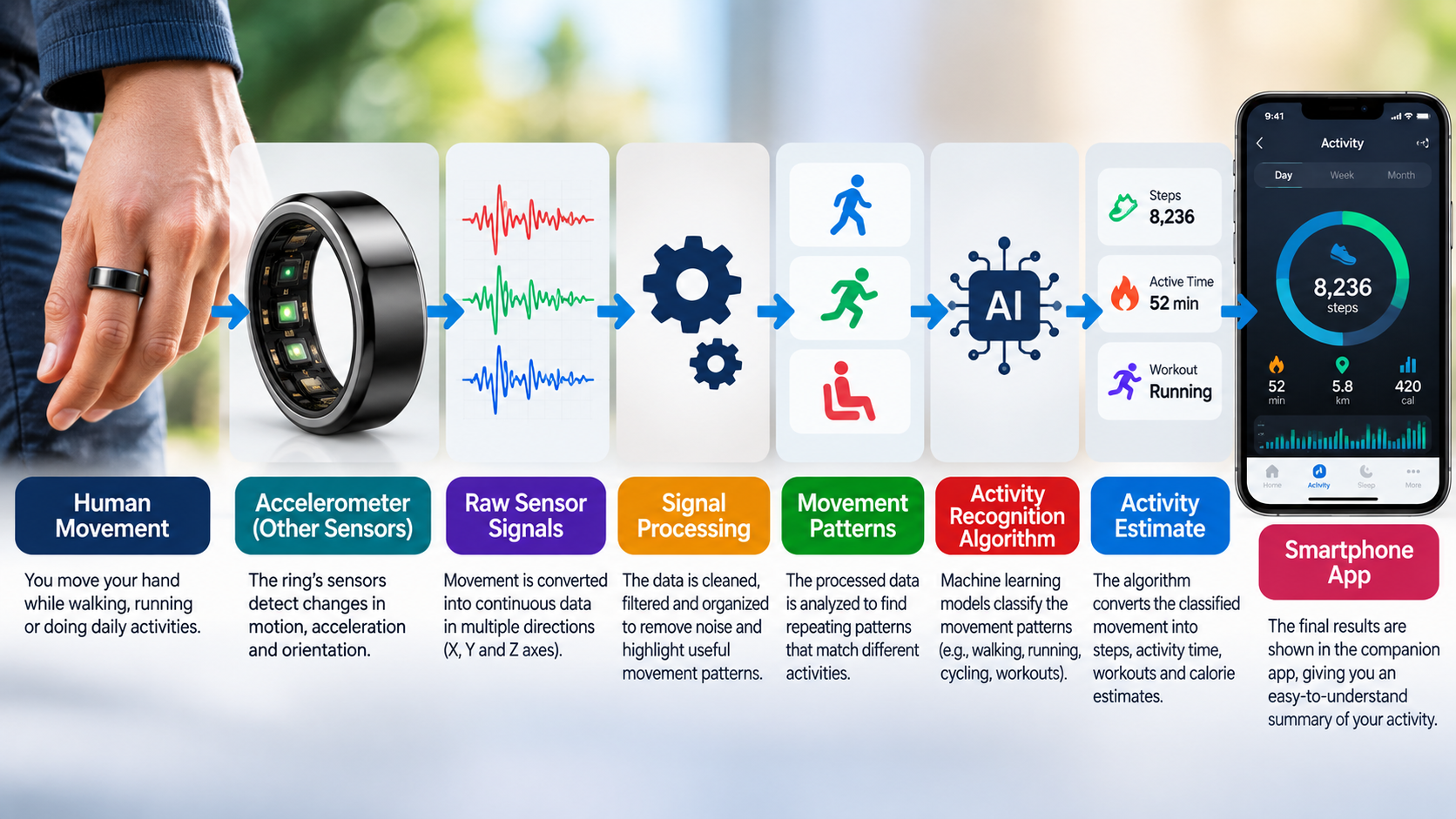
The basic process looks like this:
Your movement → sensor measurements → signal processing → movement patterns → activity recognition → app metrics
An accelerometer is particularly important because it measures acceleration along multiple axes. Oura says its ring uses a 3D accelerometer to track activity and movement in all directions. Samsung likewise identifies the accelerometer in Galaxy Ring as the sensor used to track body movement and activity such as walking and running.
But the sensor is only the beginning.
A smart ring’s sensor measures physical signals; its algorithms interpret those signals as possible activities.
That is why the technology is more interesting than simply saying, “The ring has an accelerometer.”
What sensors inside a smart ring actually measure
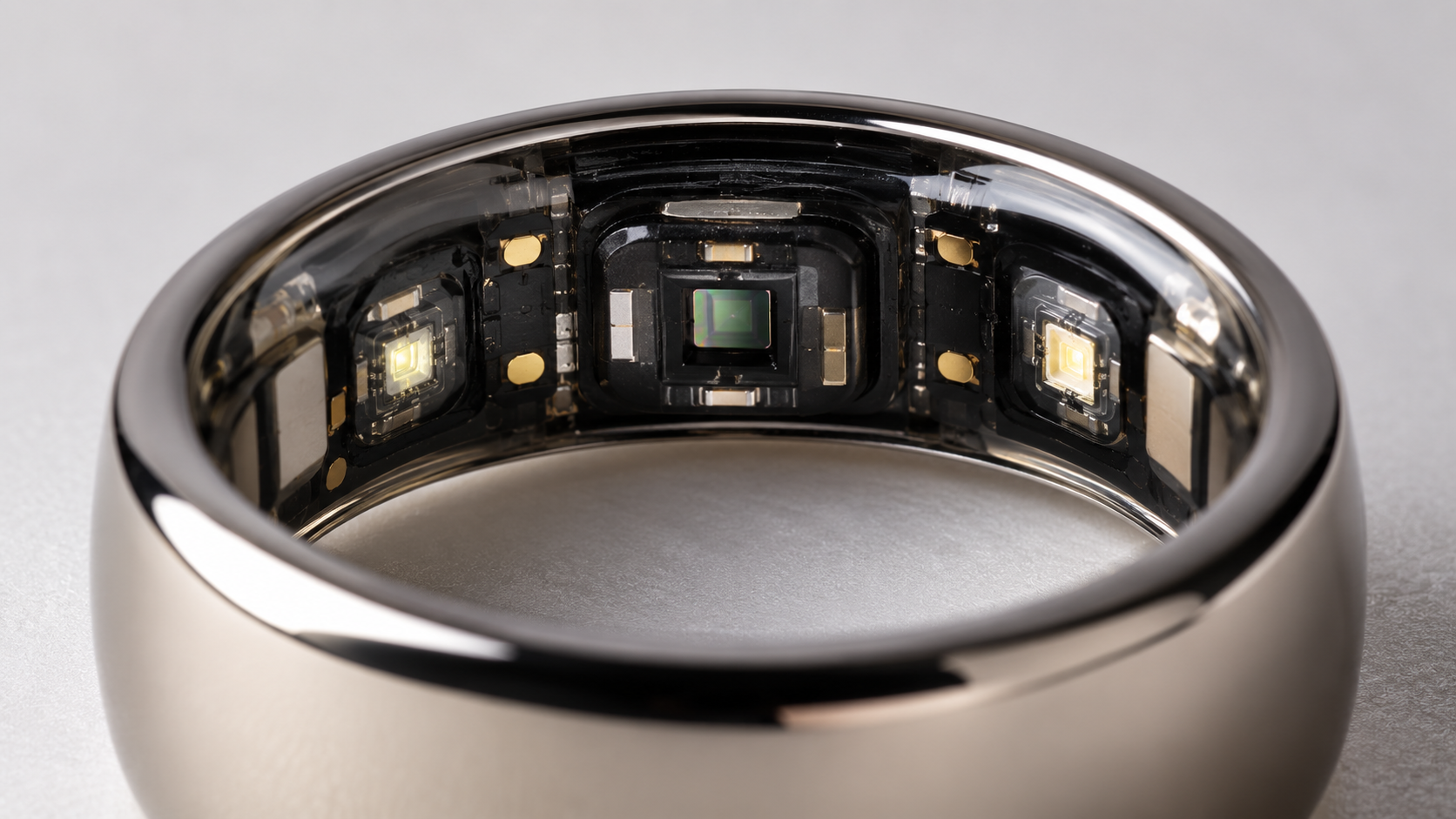
A smart ring has very little physical space compared with a smartwatch or phone, so every sensor has to earn its place. The exact hardware varies between products, but motion sensing is central to activity tracking.
Accelerometers: the main motion sensor
An accelerometer measures changes in acceleration. In a wearable, this information can describe how the device moves along different axes.
Think about taking a normal step. Your finger doesn’t stay perfectly still. As your arm moves forward and backward, your hand changes position and speed. The ring’s accelerometer records those changes as a stream of sensor data.
The important point is that the accelerometer doesn’t receive a message saying:
“The wearer just took a step.”
It receives physical measurements.
Software then has to make sense of them.
Oura says its activity system uses a 3D accelerometer to measure movement in all directions and that its algorithms identify step patterns from data collected at the finger.
What does “3-axis” mean?
A three-axis accelerometer can measure movement along three perpendicular directions, commonly represented as:
- X-axis
- Y-axis
- Z-axis
Together, these measurements provide a more complete picture of how the ring is moving than a single-direction sensor would.
Imagine holding your hand out and rotating it while walking. The movement isn’t happening in one perfectly straight line. A three-dimensional sensor can capture changes across multiple directions.
That richer motion signal gives activity-recognition software more information to work with.
Gyroscopes: useful for rotational movement
A gyroscope measures angular velocity, meaning how quickly an object rotates around an axis.
This is different from acceleration.
An accelerometer helps describe linear acceleration and changes in movement, while a gyroscope provides information about rotation.
That distinction becomes useful when studying human movement because the body and wearable device are constantly changing orientation.
Research into wearable human-activity recognition commonly uses inertial sensors such as accelerometers and gyroscopes. These sensors can provide information about acceleration, angular velocity and orientation that can help distinguish different activity patterns.
However, don’t make the common mistake of assuming that every smart ring contains a gyroscope.
For example, Samsung’s current Galaxy Ring specifications list an accelerometer, optical heart-rate sensor and temperature sensor; a gyroscope is not listed among those sensors.
So when comparing smart rings, always check the specific model’s official specifications rather than assuming that every wearable uses the same sensor package.
Other sensors can provide context
Motion isn’t the only information a smart ring can collect.
Depending on the device, additional sensors may include:
- Optical heart-rate sensors
- Skin-temperature sensors
- Other physiological sensors
Samsung, for example, lists an optical heart-rate sensor and temperature sensor alongside the accelerometer in Galaxy Ring.
These sensors don’t replace the accelerometer. They provide different types of information.
That distinction is important because activity tracking and physiological tracking are related but not identical tasks.
From raw movement to a step count
This is where the technology gets interesting.
A ring doesn’t receive neatly organized data saying:
Step 1. Step 2. Step 3.
Instead, it continuously collects motion signals. The software must determine which portions of that signal look like walking or running and which portions represent other movements.
The ring captures continuous motion
Imagine walking across your room.
Your hand moves.
Your fingers move.
Your arm swings.
Your body accelerates and decelerates.
The ring moves with your finger throughout the process.
The accelerometer records these changes as sensor data. That data may contain useful patterns, but it can also contain noise and unrelated movement.
Now imagine that you stop walking and start washing dishes.
Your hand is still moving.
The sensor doesn’t suddenly become aware that you’re in the kitchen.
It simply continues recording motion.
The software has to distinguish between those patterns.
Algorithms look for recognizable patterns
Activity-recognition systems can analyze characteristics such as:
- Movement intensity
- Direction
- Timing
- Repetition
- Changes in acceleration
- Rotational behavior where relevant
- The duration of a movement pattern
Oura says its activity algorithms are tuned to recognize steps from finger-collected movement data and can identify step patterns within a small 30-second window.
This illustrates an important principle:
Step counting is an interpretation of motion data, not a simple physical count of every movement.
Not every finger movement is a step
This is one of the easiest concepts to misunderstand.
Suppose you’re sitting at your desk and repeatedly moving your hand to use a mouse. Your finger and hand are moving, but you’re not walking.
If every detected movement were counted as a step, your daily step total would become ridiculous.
Instead, activity algorithms attempt to identify patterns associated with actual steps and distinguish them from other forms of movement.
That is why the software matters just as much as the sensor.
Why a smart ring needs algorithms, not just a motion sensor
A sensor can tell a device that something moved.
It cannot, by itself, reliably explain what that movement means.
That job belongs to software.
Signal processing comes first
Raw sensor signals are rarely ready to interpret immediately.
A wearable system may need to process sensor data to make useful patterns easier to identify. Research into wearable human-activity recognition describes approaches involving preprocessing, noise removal, normalization and feature extraction before activity classification.
At a high level, the process can look like this:
Raw signal → cleaner signal → useful features → recognizable pattern
The exact processing pipeline used by a commercial smart ring may be proprietary, so the article should not pretend to know the internal algorithm unless the manufacturer has documented it.
Activity recognition turns patterns into categories
Once sensor information has been processed, an activity-recognition system can attempt to classify the movement.
Possible categories might include:
- Walking
- Running
- Resting
- General movement
- Exercise
- Other recognized activities
Wearable activity-recognition research has explored both conventional machine-learning techniques and deep-learning approaches for classifying physical activities from sensor data.
The commercial implementation can vary significantly between products.
That means two rings can observe similar movement but produce somewhat different results.
Where machine learning fits
Machine learning is useful because human movement is messy.
People don’t walk with perfectly identical steps. They change speed, carry bags, hold phones, climb stairs, move their arms differently and switch activities throughout the day.
A recognition model can learn relationships between sensor patterns and known activity categories.
At a simplified level:
Input: sensor data
Processing: pattern recognition
Output: probable activity
That’s the basic idea behind many wearable activity-recognition systems.
It doesn’t mean the ring “understands” your activity in the human sense. It means its software identifies patterns that correspond to known categories.
The same activity can look very different to a smart ring
Here’s a practical problem that makes activity tracking harder than it appears.
Walking normally
When you walk with your arms moving naturally, your finger experiences a relatively repeatable pattern.
That makes walking easier to identify.
Walking while holding your phone
Now your hand may move differently.
The underlying activity hasn’t changed, but the ring’s local movement signal can change.
Walking while pushing a shopping cart
Your legs are still walking, but your hands may remain relatively fixed on the cart.
This creates a different sensing situation from normal arm-swinging.
Washing dishes
Your hands can move continuously without you taking a single step.
This is exactly the kind of situation where the algorithm needs to distinguish general hand movement from walking.
Cycling
You’re moving substantially, but the movement signature at your finger can differ considerably from walking or running.
Weight training
Strength training creates another challenge because hand position, grip and movement can vary significantly from one exercise to another.
The takeaway is simple:
The ring doesn’t directly observe the activity. It observes movement associated with the activity.
That is why unusual or ambiguous movement can be harder for automated classification.
Why your smart ring and smartwatch may show different step counts
Have you ever looked at two fitness devices and wondered why one says 7,800 steps while the other says 8,400?
That doesn’t automatically mean one device is broken.
Different wearable devices can use different sensors, locations, algorithms and classification rules.
Oura explicitly explains that different trackers can produce different step estimates because they use different methods for categorizing steps and may have differences in algorithms, sensor types, materials and other factors.
Common reasons for different readings
| Situation | Why readings can differ |
|---|---|
| Ring vs smartwatch | Sensors are located on different parts of the body |
| Walking while carrying something | Natural arm/finger movement changes |
| Short walks | Devices may apply different activity thresholds |
| Different workouts | Movement patterns vary by activity |
| Ring orientation | Sensor position can affect measurements |
| Different algorithms | Devices classify movement differently |
| Missing wear time | One device may have data the other doesn’t |
The key lesson is not to treat every wearable’s number as though it came from the same measurement system.
If you’re tracking your own activity over time, consistency can be more useful than constantly comparing unrelated numbers.
Oura itself recommends analyzing data from one device rather than making direct comparisons between different trackers because of these methodological differences.
How smart rings recognize workouts
Step counting is only one part of activity tracking.
Modern smart rings can also use movement and other sensor information to identify supported activities or workouts.
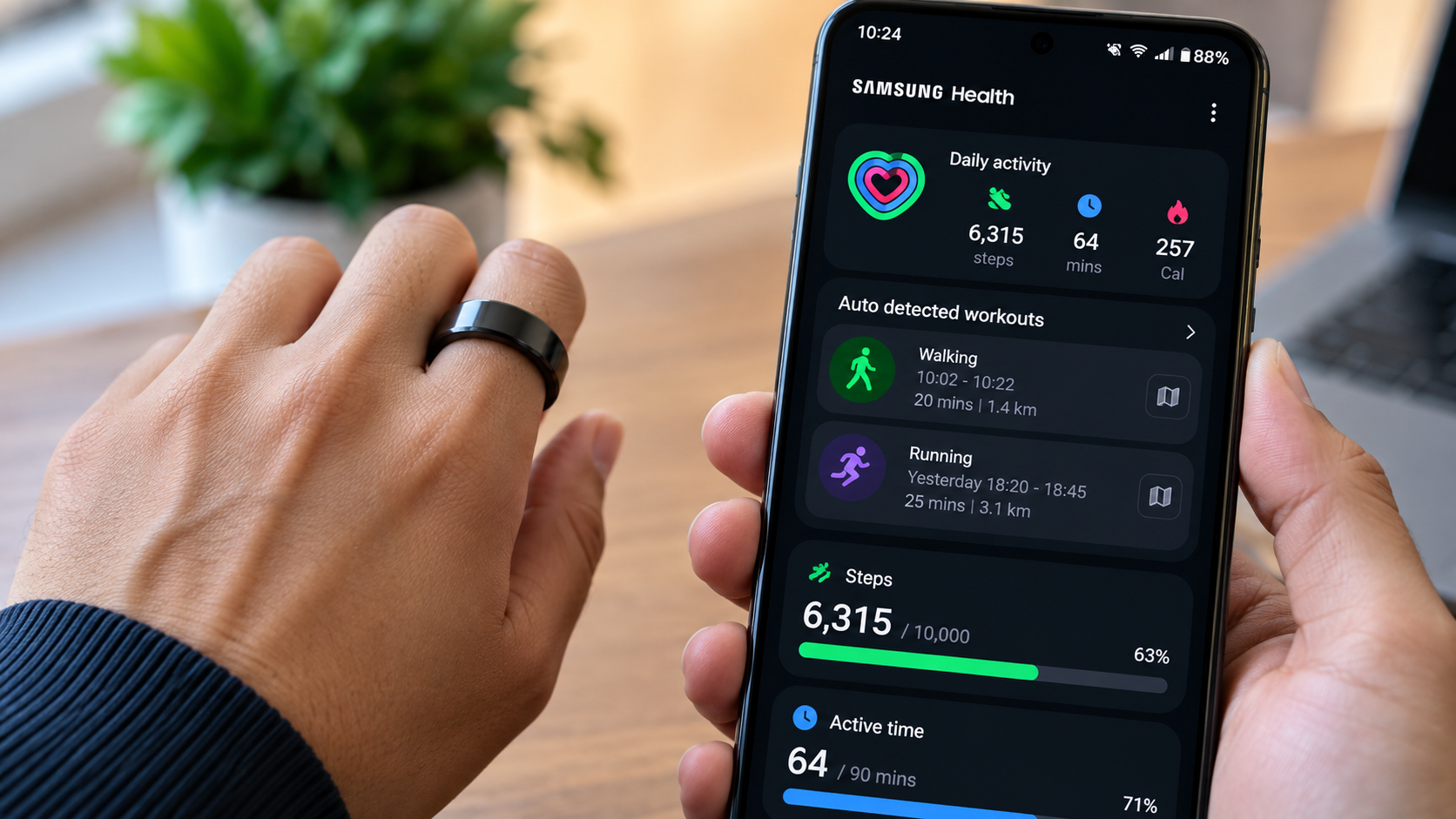
Automatic activity detection
Automatic detection generally works by looking for movement patterns associated with particular activities.
Samsung says Galaxy Ring can track activities such as walking and running through its accelerometer, and Samsung’s support documentation describes automatic exercise detection for supported activities.
The important phrase is supported activities.
A ring doesn’t necessarily recognize every workout you could possibly perform.
Why automatic detection can miss things
Short workouts can be difficult to classify.
Unusual exercises can be difficult.
Activities with limited hand movement can also create challenges because the ring is sensing movement from your finger rather than directly observing your entire body.
That doesn’t make automatic detection useless. It simply explains why it should be treated as an automated estimate rather than an infallible observer.
When manual activity logging helps
Some activities are harder to identify from motion alone.
Oura specifically notes that non-step-based activities such as yoga can be more difficult to measure and says manually adding activities can improve its Activity Score.
This is a useful reminder that human input can still complement automated sensing.
What happens when calories enter the picture?
This is where wearable marketing can sometimes make a complicated process sound simpler than it really is.
A motion sensor does not directly measure the calories you burn.
Calorie or energy-expenditure numbers are estimates generated from activity information and, depending on the device, physiological measurements and software models.
Oura, for example, explains that it uses METs—Metabolic Equivalents—to calculate daily energy expenditure and active calorie burn. Its documentation also distinguishes active calorie burn from total burn.
That means you should think of a calorie number as an estimate produced by a model, not as a tiny calorie meter inside the ring.
Steps, activity and calories are different metrics
They answer different questions.
Steps: How much step-like movement did the system identify?
Activity time: How much recognized or logged activity occurred?
Calories: How much energy expenditure does the model estimate?
Keeping these separate makes wearable data much easier to understand.
What can make smart-ring activity tracking less reliable?
No wearable sensor is perfect, and activity recognition has inherent limitations.
Some factors can make interpretation harder:
- Incorrect ring orientation
- Poor or inconsistent fit
- Removing the ring during activity
- Unusual movement patterns
- Activities with little hand movement
- Short bursts of activity
- Repetitive hand movements
- Different algorithmic thresholds
- Gaps in recorded data
Oura specifically recommends placing its ring’s sensor bumps on the palm side of the finger for more accurate activity tracking. It also notes that manually adding activities can help when activities are harder to detect automatically.
Samsung likewise notes that measurement accuracy can vary depending on factors such as walking patterns, exercise routines and lifestyle.
So if your smart ring misses a short workout or reports a slightly different number from another wearable, the right response isn’t necessarily, “The ring is inaccurate.”
A better question is:
What was the device actually designed and calibrated to recognize?
Smart rings vs smartwatches for activity tracking
Smart rings and smartwatches approach activity tracking from different physical designs.
| Smart ring | Smartwatch |
|---|---|
| Worn on the finger | Worn on the wrist |
| Small and discreet | Larger interactive device |
| Designed for passive tracking | Stronger emphasis on on-device interaction |
| Usually little or no display | Built-in display |
| Convenient for continuous wear | Useful for real-time workout information |
| Compact sensor package | More room for sensors, controls and display |
Neither form factor automatically wins every measurement scenario.
A smartwatch can be particularly useful when you’re actively exercising and want to see workout information on your wrist. A ring can be attractive when the priority is discreet, continuous tracking without wearing a screen.
The more useful question is not “Which device is universally better?”
It’s:
Which form factor fits the way you actually want to track activity?
A simple look inside the activity-tracking pipeline
The easiest way to understand the whole system is to follow one movement from your body to your phone.
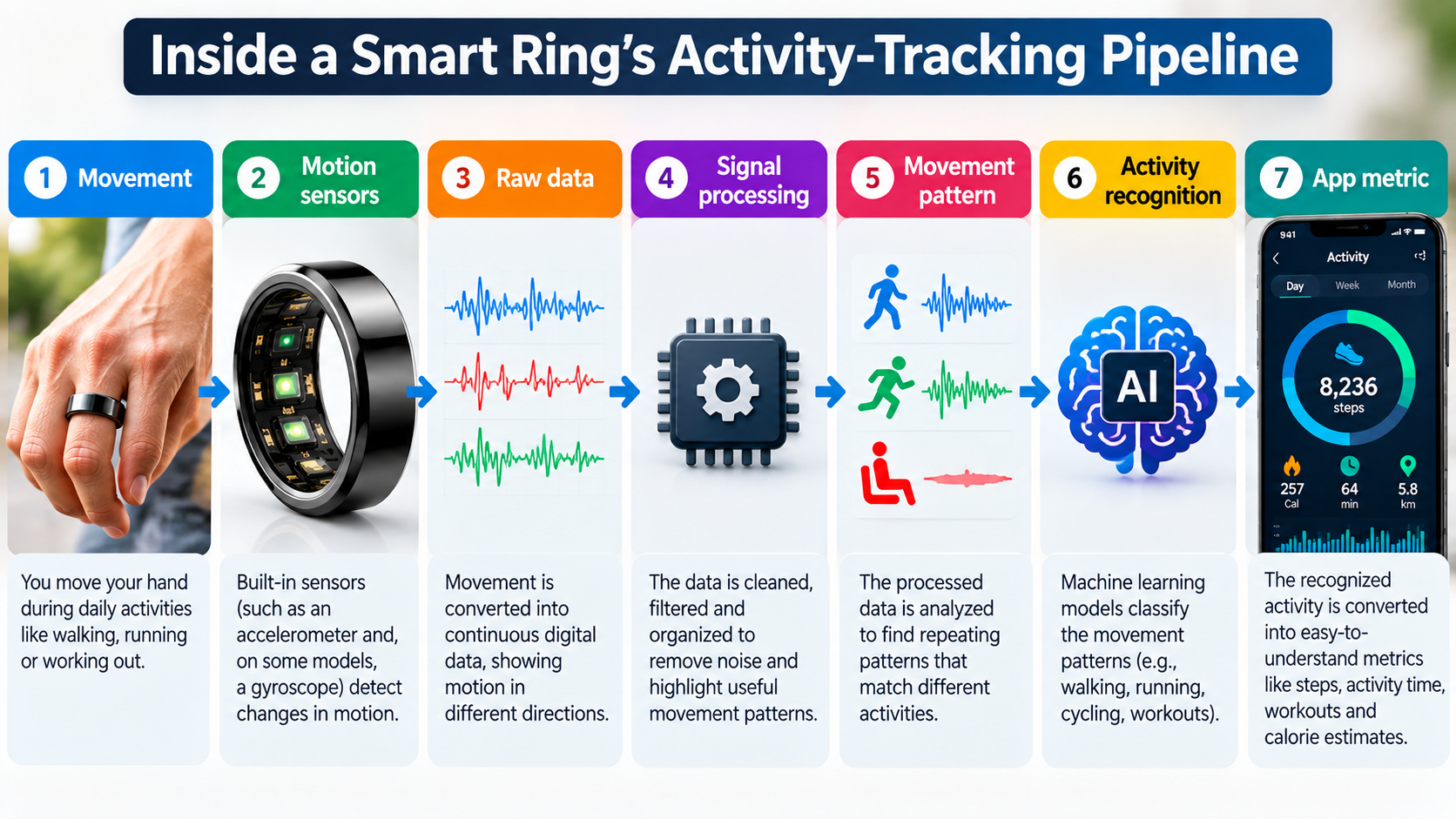
1. Your body moves
You walk, run, exercise or perform an everyday task.
2. The sensors record physical changes
The accelerometer records movement-related acceleration. Other sensors may contribute additional physiological or motion context depending on the product.
3. Software processes the signal
The system prepares the data for interpretation.
4. Patterns emerge
The software looks at characteristics such as timing, intensity and repetition.
5. An algorithm classifies the movement
The system estimates what the pattern most likely represents.
6. The device generates a metric
That may become a step count, activity duration, workout record or energy estimate.
7. The app presents the result
The complicated sensor data becomes a simple number or chart that you can understand.
That’s the real story behind how smart rings track activity.
What smart rings can and cannot tell you
A smart ring can provide useful estimates of your activity, but it isn’t watching your body like a human observer.
A smart ring can estimate
- Steps
- Movement
- Activity duration
- Supported workout types
- Activity intensity
- Energy expenditure
- Long-term activity patterns
A smart ring cannot directly observe everything
It doesn’t know your exact intentions.
It doesn’t directly measure the calories contained in the food you eat.
It doesn’t guarantee that every movement classification is correct.
And it doesn’t turn an estimate into a clinical measurement simply because the number appears precise on a smartphone screen.
This distinction becomes particularly important when interpreting calorie or exercise data.
How to get more consistent activity data from a smart ring
If you want your activity history to be useful, consistency matters.
1. Wear the ring correctly
Follow the manufacturer’s instructions for orientation and fit.
2. Wear it consistently
If the ring is sitting in a drawer during your workout, it cannot record that movement.
Oura specifically notes that not wearing the ring during activity can affect active-calorie estimates and recommends manually adding or importing activities when appropriate.
3. Don’t compare every number with another device
A difference of a few hundred steps doesn’t automatically tell you which device is correct.
Different sensors and algorithms can produce different estimates.
4. Manually log difficult activities
If your device struggles with a particular activity, manual logging can provide additional context.
5. Look at trends
If your ring consistently shows that you were more active this week than last week, that trend may be more useful than worrying about whether a single day’s total differs from your smartwatch by 200 steps.
The goal of wearable tracking is often not perfect measurement of every second.
It’s useful information about your behavior over time.
Pros and Cons of Smart-Ring Activity Tracking
Pros
- Compact form factor: A ring is considerably less intrusive than a larger wearable with a screen.
- Continuous tracking potential: Its small size makes it practical for people who prefer passive monitoring.
- Finger-based sensing: Movement is captured directly from the finger rather than the wrist.
- Automatic activity recognition: Supported models can identify certain activities without requiring manual input.
- Multiple sensor types: Some rings combine motion sensing with heart-rate and temperature measurements.
- Long-term trends: Repeated measurements can help users understand changes in their activity patterns over time.
Cons
- Sensor configurations vary: There is no universal smart-ring hardware design.
- Algorithms differ: Two rings can interpret similar movement differently.
- Some activities are harder to detect: Especially activities where finger movement doesn’t closely reflect whole-body movement.
- Calories are estimates: Energy expenditure is calculated rather than directly measured by a motion sensor.
- No universal accuracy number: Performance depends on the device, activity and circumstances.
- Limited on-device feedback: Most smart rings aren’t designed to replace a smartwatch screen during a workout.
The most useful way to view these considerations is not as reasons to dismiss smart rings, but as reminders to understand what the numbers actually represent.
Frequently Asked Questions
How does a smart ring count steps?
A smart ring uses motion data, particularly from an accelerometer, and software algorithms that identify patterns associated with walking and other step-based movement. Oura, for example, says its 3D accelerometer records movement and its algorithms identify step patterns from finger-collected data.
Do all smart rings have accelerometers?
You should check the specifications of the particular ring. Accelerometers are widely used for wearable activity tracking, and Samsung officially lists one in Galaxy Ring. However, sensor configurations can differ between products.
Do smart rings have gyroscopes?
Some wearable systems use gyroscopes to measure angular motion, but a gyroscope should not be assumed to be present in every smart ring. Samsung’s current Galaxy Ring specifications list an accelerometer, optical heart-rate sensor and temperature sensor rather than a gyroscope.
How accurate are smart ring activity trackers?
Accuracy varies by device, activity and circumstances. Sensor position, ring orientation, movement patterns and the manufacturer’s algorithms can all affect results. Rather than assuming one universal accuracy figure applies to every smart ring, check independent validation for the specific device and metric you’re interested in.
Why does my smart ring show a different step count from my smartwatch?
Different devices can use different sensor locations, algorithms and definitions of what counts as a step. Oura specifically notes that different trackers may produce different estimates for these reasons.
Can smart rings detect workouts automatically?
Some can detect supported activities automatically. Samsung, for example, documents automatic detection for supported exercises, while Oura provides Automatic Activity Detection and also allows activities to be manually added when necessary. The exact supported activities vary by product.
What should you look at when evaluating a smart ring’s activity tracking?
If you’re considering buying a smart ring, don’t stop at the phrase “activity tracking.”
Look at the details behind it.
Check:
- Which motion sensors does it actually contain?
- Does the manufacturer explain its activity detection?
- Which activities can it automatically recognize?
- Can activities be added manually?
- How does it handle calories?
- Does the manufacturer provide documentation about sensor placement?
- Are there independent studies or credible tests for the specific model?
- Does the companion app provide useful long-term trends?
- Does the ring fit comfortably enough that you’ll actually wear it?
That last question is easy to overlook.
A theoretically sophisticated tracker isn’t very useful if you regularly remove it.
Conclusion
The easiest way to understand how smart rings track activity is to stop thinking of them as tiny step counters.
They’re miniature sensing systems.
The accelerometer captures changes in movement. Other sensors can provide additional context. Software processes the raw signals, identifies patterns and attempts to classify those patterns as walking, running, exercise or other activities. The final number you see in an app is therefore the result of measurement plus interpretation.
That also explains why two wearables can disagree.
Your ring and smartwatch may be looking at the same day from different sensor positions and using different algorithms. Neither number should automatically be treated as an absolute truth.
For everyday use, the real value of a smart ring is often in the pattern over time: how active you are, how your activity changes and how consistently you move.
The sensor collects the evidence.
The algorithm gives that evidence meaning.




1 thought on “How Smart Rings Track Activity: Sensors, Algorithms & Movement 2026”