
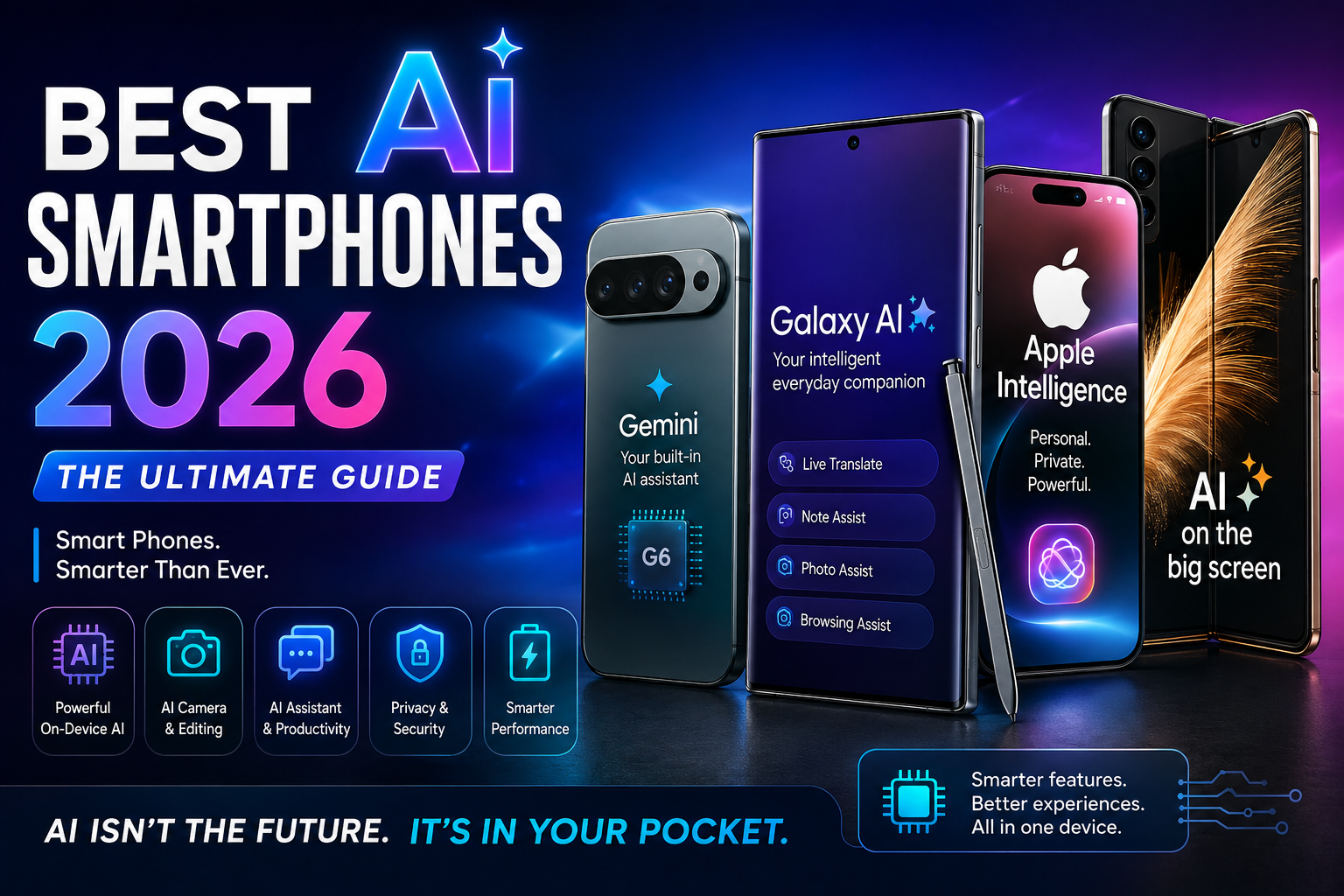
You’ve probably already noticed that AI has become one of the biggest smartphone features in 2026, alongside cameras, processors, displays, and battery life. Best AI Smartphones 2026, However, not every phone with an “AI” label offers equally useful capabilities, so this guide focuses on what the AI actually does and which phones make the most sense for different users.
Key Takeaways
- AI smartphones combine machine-learning and generative-AI capabilities with smartphone hardware and software to improve photography, productivity, communication, personalization, and content creation.
- The best AI smartphone depends on practical AI capabilities, hardware performance, software support, privacy, ecosystem, price, and your primary needs.
- On-device AI can process selected AI tasks directly on the smartphone, improving responsiveness and potentially supporting offline functionality and privacy.
- AI camera features can improve image processing, editing, object removal, zoom, portrait effects, and other computational-photography tasks.
- Generative AI and AI assistants can help with writing, translation, summarization, image creation, research, and everyday tasks.
- AI feature availability varies by country, language, device, software version, account, and subscription, so buyers should verify availability before purchasing.
- The smartest buying decision is to compare real-world AI usefulness instead of choosing a phone simply because it advertises the largest number of AI features.
What Are AI Smartphones in 2026?
AI smartphones are mobile devices that use machine-learning and generative-AI capabilities to improve photography, communication, productivity, personalization, and content creation. Instead of treating AI as a separate application, modern phones increasingly integrate intelligence into the camera, operating system, assistant, search, messaging, editing, and other everyday functions.
For example, Google’s Pixel 11 series uses the Tensor G6 chip and the latest Gemini Nano model, while Samsung’s latest Galaxy devices combine dedicated AI hardware with Galaxy AI features. Apple’s current iPhone lineup uses Apple Intelligence with on-device processing and Private Cloud Compute for more complex requests.
Moreover, generative-AI-capable smartphones are becoming mainstream rather than niche products. Counterpoint Research forecasts that GenAI-capable smartphones will account for 45% of global smartphone shipments in 2026, compared with 36% in 2025. – Source: Google, 2026
What Makes a Smartphone an AI Phone?
An AI phone uses specialized hardware and software to perform or accelerate intelligent tasks locally, through cloud services, or through a combination of both. The important difference is how deeply AI is integrated into the phone rather than whether the manufacturer simply uses the word “AI” in its marketing.
For example, an AI phone can recognize objects through the camera, summarize a recorded meeting, translate a conversation, rewrite a message, remove an unwanted person from a photo, or provide context-aware suggestions.
At the same time, AI processing can happen either on the device or in the cloud. Qualcomm’s Snapdragon 8 Elite Gen 5, for example, includes a dedicated Hexagon NPU and is designed to support personalized on-device agentic AI experiences. – Source: Qualcomm, 2026
Why Do AI Smartphones Matter in 2026?
AI smartphones matter in 2026 because AI is becoming a core part of everyday mobile computing rather than an optional extra. AI can reduce the number of steps required for common tasks such as editing photos, finding information, translating languages, summarizing content, and organizing personal information.
For example, Samsung describes its Galaxy S26 generation as its third generation of AI phones, with AI designed to help users manage plans, find information, capture content, and refine content.
Furthermore, AI capability is increasingly concentrated in premium smartphones. Counterpoint Research says GenAI capability has become standard among high-end smartphones above the $400 wholesale price level, although it also notes that AI has not yet become a universally compelling reason for consumers to upgrade. – Source: Counterpoint Research, 2026
How AI Changes Smartphone Photography
AI photography uses computational intelligence to improve how a phone captures, processes, edits, and understands images. Modern AI cameras can recognize scenes, improve low-light images, remove distractions, enhance faces, process zoom, and generate or modify visual content.
For example, the iPhone 17 Pro combines Apple Intelligence with features such as Visual Intelligence and Clean Up, while OPPO’s Find X9 Pro combines AI-powered imaging with a 200MP Hasselblad telephoto system and AI-assisted long-range zoom.
Best Smart Rings in India
How AI Improves Productivity
AI productivity features help smartphones understand information and reduce repetitive work. These features can include transcription, summarization, writing assistance, translation, contextual suggestions, and personal information retrieval.
For example, Apple’s next-generation Siri is designed to understand personal context and retrieve relevant information from messages, emails, photos, and other apps.
What Are the Best AI Smartphones in 2026?
The best AI smartphones in 2026 include leading models from Google, Samsung, Apple, OPPO, Xiaomi, and other flagship manufacturers, with each emphasizing different AI strengths. Instead of selecting one universal winner, the better approach is to match each phone’s AI capabilities with your priorities.
As of September 2026, the strongest premium contenders include the Google Pixel 11 Pro XL, Samsung Galaxy S26 Ultra, Apple iPhone 17 Pro Max, Samsung Galaxy Z Fold8, OPPO Find X9 Pro, and Xiaomi 17 Ultra.
| Smartphone | Main AI Strength | Best For | Standout AI/Tech Area |
| Google Pixel 11 Pro XL | Gemini Intelligence | AI-first users | Gemini + Tensor G6 |
| Samsung Galaxy S26 Ultra | Galaxy AI | Productivity | Context-aware AI |
| iPhone 17 Pro Max | Apple Intelligence | iOS users | Visual Intelligence + Siri |
| Galaxy Z Fold8 | Galaxy AI + multitasking | Power users | AI on large foldable display |
| OPPO Find X9 Pro | AI photography + productivity | Creators | AI Mind Space + imaging |
| Xiaomi 17 Ultra | HyperAI + imaging | Photography enthusiasts | Leica imaging + AI |
The Pixel 11 series launched in August 2026 with the Tensor G6 processor and Gemini Nano, while Samsung’s Galaxy S26 generation emphasizes proactive and adaptive Galaxy AI.
Which AI Smartphone Is Best for Overall AI Features?
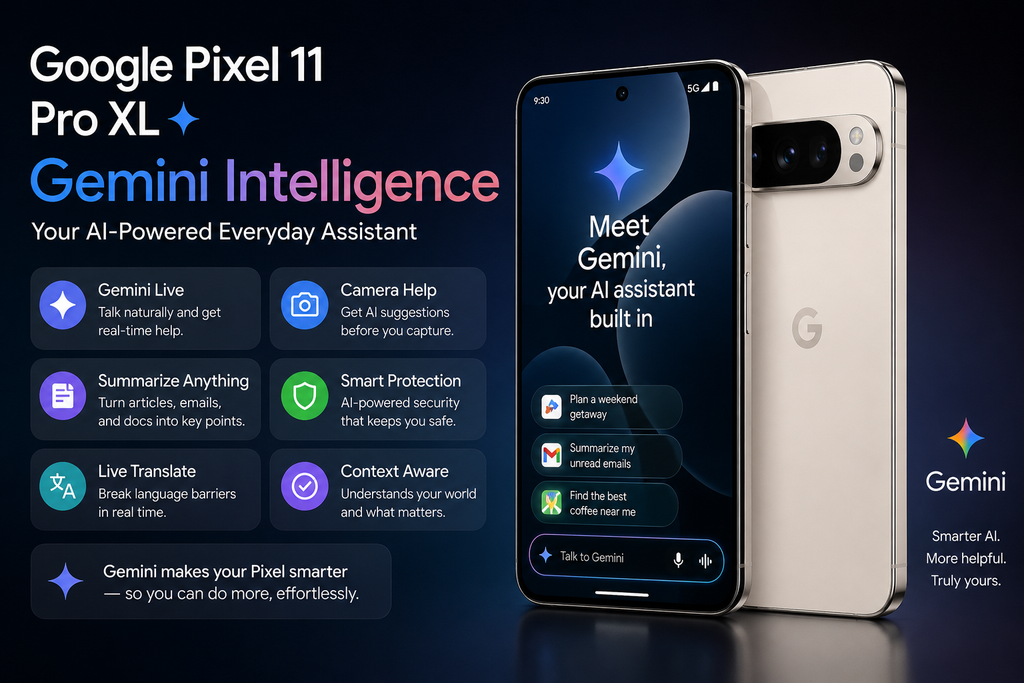
The Google Pixel 11 Pro XL is one of the strongest choices for users who want an AI-first Android experience. Google’s approach puts Gemini and contextual assistance deeply into the Pixel experience, while the Tensor G6 platform is specifically designed around Google’s AI ecosystem.
For example, Google says the Pixel 11 series is designed for “Gemini Intelligence” and uses its latest Gemini Nano model on Tensor G6.
Moreover, the Pixel approach is particularly attractive if you want AI assistance integrated into everyday Android workflows, rather than using AI only through a separate chatbot application.
Which AI Smartphone Is Best for Productivity?
The Samsung Galaxy S26 Ultra is a strong choice for productivity-focused users who want AI integrated into communication, organization, and multitasking. Samsung’s latest Galaxy AI platform is designed around contextual assistance and reducing the number of steps required to complete everyday tasks.
For example, Samsung describes the Galaxy S26 generation as capable of handling tasks in the background so users can focus more on the result rather than the process.
In addition, Samsung’s Galaxy AI ecosystem extends beyond phones into tablets, watches, earbuds, and other connected devices. Samsung states that Galaxy AI is supported on smartphones beginning with the Galaxy S24 series, although available features vary by device and operating-system version.
What Makes Galaxy AI Useful?
Galaxy AI is useful when you want AI assistance embedded into multiple parts of the Samsung ecosystem. The platform covers tasks involving communication, photography, information discovery, and contextual suggestions.
For example, Samsung’s newer Galaxy AI experience includes features such as Now Nudge and Now Brief, while newer devices also support AI-powered photo and video tools.
Which AI Smartphone Is Best for Photography and Content Creation?
The OPPO Find X9 Pro and Xiaomi 17 Ultra stand out for buyers who want AI combined with advanced imaging hardware. These phones focus heavily on computational photography, long-range imaging, video creation, and AI-assisted editing.
For example, the OPPO Find X9 Pro combines a 200MP Hasselblad telephoto camera, AI-powered 120x zoom, 4K 120fps Dolby Vision recording, and AI Mind Space.
Similarly, the Xiaomi 17 Ultra combines HyperAI with Leica imaging, a 200MP continuous optical zoom system, a 1-inch LOFIC sensor, 4K 120fps recording, and Gemini integration.
Why AI Camera Hardware Still Matters
AI cannot completely replace strong camera hardware because image quality depends on sensors, lenses, stabilization, processing, and software working together. A powerful AI model can improve an image, but better optical hardware gives the AI more useful information to work with.
For example, OPPO’s Find X9 Pro uses a large main sensor and dedicated telephoto hardware before applying computational processing to the resulting image.
Which AI Smartphone Is Best for iPhone Users?
The iPhone 17 Pro Max is a strong AI choice for users who prioritize Apple Intelligence, privacy, iOS integration, and the Apple ecosystem. Apple integrates AI into areas such as Visual Intelligence, writing assistance, image creation, translation, Photos, Safari, and Siri.
For example, Apple’s current Apple Intelligence system uses on-device processing and Private Cloud Compute for more complex requests, with Apple stating that Private Cloud Compute is designed so user data is not stored.
Furthermore, Apple’s June 2026 announcement introduced a more capable Siri AI with personal-context understanding, onscreen awareness, web knowledge, and deeper integration across apps. – Source: Apple, 2026
Is Apple Intelligence Available Everywhere?
Apple Intelligence availability depends on device, language, region, and feature. Apple currently lists support for multiple languages, but explicitly notes that some features may not be available in every region or language.
For example, Apple’s 2026 announcement lists 18 supported languages for Apple Intelligence and notes that some features can vary by region or language.
Is the Samsung Galaxy Z Fold8 a Good AI Smartphone?
The Galaxy Z Fold8 is a strong AI smartphone for users who want a large-screen productivity experience without giving up smartphone portability. Its foldable design gives AI tools more screen space for multitasking, content creation, editing, and research.
For example, Samsung’s Z Fold8 uses the Snapdragon 8 Elite Gen 5 for Galaxy and includes features such as Photo Assist, personalized editing prompts, and Now Nudge.
Moreover, Samsung lists 7x OS upgrades and security updates for the Z Fold8, making long-term software support an important part of its value proposition.
What AI Features Should You Look for in a Smartphone?
The most important AI smartphone features are useful capabilities that save time, improve results, or make everyday interactions easier. Buyers should evaluate what the AI actually does rather than simply counting the number of AI-branded features.
1. Generative AI
Generative AI allows a smartphone to create or transform content such as text and images. For example, you might use an AI image tool to remove an unwanted object, create an image variation, or transform an existing picture.
2. AI Assistants
AI assistants use natural-language interaction to help users find information and perform tasks. Google’s Gemini, Samsung’s Galaxy AI ecosystem, and Apple’s Siri AI represent different approaches to increasingly contextual smartphone assistance.
3. AI Camera Processing
AI camera processing uses computational models to improve captured photos and videos. For example, AI can identify subjects, improve low-light processing, enhance zoom, and remove unwanted distractions.
4. Translation and Transcription
AI translation and transcription convert spoken or written language into another language or structured text. Apple’s Live Translation and AI-powered transcription features demonstrate how smartphones can reduce communication barriers.
5. On-Device AI
On-device AI processes selected models or AI operations directly on smartphone hardware. Qualcomm’s latest flagship platform, for example, includes a dedicated NPU designed to accelerate AI workloads on the device.
6. AI Privacy
AI privacy describes how a phone handles personal information when AI features process user data. Apple’s combination of on-device processing and Private Cloud Compute is one example of a manufacturer making privacy architecture part of its AI strategy.
How Do the Best AI Smartphones Compare?
The best AI smartphones differ mainly in how they combine AI assistants, camera intelligence, hardware acceleration, software integration, and ecosystem features. A phone that is excellent for AI photography may not be the best choice for productivity or privacy.
| Category | Strong Choice | Why |
| AI-first Android | Pixel 11 Pro XL | Deep Gemini integration |
| Productivity | Galaxy S26 Ultra | Galaxy AI + ecosystem |
| iOS AI | iPhone 17 Pro Max | Apple Intelligence |
| Foldable AI | Galaxy Z Fold8 | Large-screen AI workflows |
| AI photography | Xiaomi 17 Ultra | Leica imaging + HyperAI |
| Creator-focused AI | OPPO Find X9 Pro | Imaging + AI Mind Space |
| Privacy-focused AI | iPhone 17 Pro Max | On-device processing + Private Cloud Compute |
First, the Pixel 11 Pro XL is particularly attractive if AI assistance is your highest priority. Google built the Pixel 11 series around Gemini Intelligence and its Tensor G6 platform.
Second, the Galaxy S26 Ultra is attractive if you want AI integrated with productivity and Samsung’s broader device ecosystem. Samsung positions Galaxy AI as a central part of its latest flagship experience.
Finally, the iPhone 17 Pro Max is especially compelling for users already invested in Apple’s ecosystem. Apple Intelligence connects AI features across supported Apple hardware while emphasizing privacy.
How Does On-Device AI Differ From Cloud AI?
On-device AI runs selected AI processing directly on the smartphone, while cloud AI sends suitable workloads to remote servers. Modern flagship phones increasingly use a hybrid approach because different AI tasks have different performance, privacy, and compute requirements.
For example, Qualcomm’s Snapdragon 8 Elite Gen 5 includes a Hexagon NPU for AI processing, while Apple’s Private Cloud Compute allows more complex requests to use server-based models while maintaining Apple’s stated privacy architecture.
| Factor | On-Device AI | Cloud AI |
| Processing | Smartphone | Remote servers |
| Internet | Can work for supported tasks without internet | Usually required |
| Speed | Potentially very fast | Depends on connection/server |
| Privacy | Data can remain on device for supported tasks | Data may leave device |
| Model size | Limited by hardware | Can support larger models |
| Best use | Local tasks and instant features | Complex generative workloads |
As such, the best AI smartphones do not necessarily choose one method exclusively. They combine local processing with cloud intelligence to balance speed, capability, battery consumption, and privacy.
What Are the Best AI Smartphones for Different Users?
The Best AI Smartphones 2026 depends on what you actually want AI to do for you. Instead of asking which phone has the most AI, identify your main use case first.
For AI Enthusiasts
Choose the Pixel 11 Pro XL if your priority is deep integration with Google’s Gemini ecosystem. Google specifically positions the Pixel 11 series around Gemini Intelligence and Tensor G6.
For Business Professionals
Choose the Galaxy S26 Ultra if productivity, multitasking, and Samsung’s ecosystem are central to your workflow. Galaxy AI is designed to assist with contextual tasks while Samsung’s flagship hardware supports demanding workloads.
For iPhone Users
Choose the iPhone 17 Pro Max if you value Apple Intelligence, iOS integration, and Apple’s privacy architecture. Apple combines on-device processing with Private Cloud Compute for supported AI tasks.
For Content Creators
Consider the OPPO Find X9 Pro or Xiaomi 17 Ultra if advanced imaging is your main priority. Both combine high-end camera hardware with AI-assisted photography and video capabilities.
For Multitaskers
Choose the Galaxy Z Fold8 if a large foldable screen improves how you work with AI tools. Its large inner display is designed for side-by-side productivity and AI-assisted workflows.
What Are the Best Tools for Testing AI Smartphones?
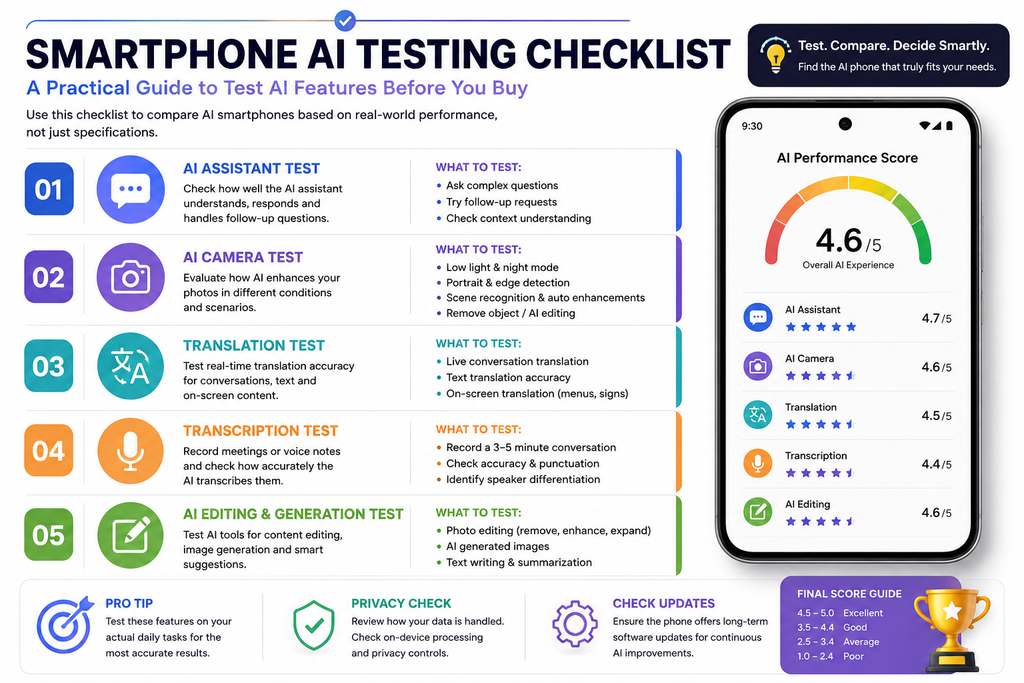
The best way to evaluate an AI smartphone is to test the AI features you personally expect to use rather than relying only on specifications. Best AI Smartphones 2026, A practical test can reveal differences that a processor or megapixel comparison cannot.
First, test the assistant with real questions and follow-up requests. Second, test camera AI with difficult photos. Third, test transcription and translation using your preferred language.
You can also compare AI results using free or widely available services such as Google Gemini, ChatGPT, Google Lens, and standard camera applications alongside the phone’s built-in tools.
Practical AI Smartphone Test
est AI smartphones 2026, A practical AI smartphone test should evaluate five areas: assistant quality, camera intelligence, productivity, performance, and privacy.
- Ask the AI assistant complex follow-up questions.
- Test AI photo editing on real photographs.
- Record a short meeting and test transcription.
- Try translation using your preferred languages.
- Check which features work offline.
- Check whether advanced features require a subscription.
- Verify regional and language availability.
How Should You Choose the Best AI Smartphone in 2026?
You should choose an AI smartphone by matching its real-world AI capabilities with your budget, daily tasks, ecosystem, privacy expectations, and expected years of use. A structured buying process helps prevent you from paying for AI features you will rarely use.
First, identify your main use case. If you create content, prioritize camera AI and video tools; if you work from your phone, prioritize assistants, transcription, multitasking, and productivity.
Second, check regional availability before buying. AI capabilities can differ according to country, language, software version, device model, and subscription.
Third, consider long-term support. Samsung, for example, lists up to seven years of OS and security updates for the Galaxy Z Fold8.
A Simple AI Smartphone Buying Checklist
A strong AI smartphone should meet your needs in at least five areas:
- AI assistant quality
- Camera and photo-editing intelligence
- On-device AI performance
- Software-update longevity
- Privacy and data handling
Moreover, do not choose a phone simply because it has the most AI features. A smaller set of reliable tools that you use every day can be more valuable than dozens of rarely used AI functions.
What’s Next for AI Smartphones?
Best AI Smartphones 2026, The next generation of AI smartphones will move from reactive assistants toward more contextual and proactive computing. Instead of waiting for you to open an AI application, future phones are increasingly designed to understand context and suggest useful actions.
Best AI Smartphones 2026, For example, Samsung is already describing newer Galaxy AI experiences in terms of proactive and adaptive assistance, while Qualcomm’s latest flagship platform emphasizes agentic AI that can understand and adapt to user behavior.
Furthermore, September 2026 is shaping up to be an unusually busy month for smartphone launches, with numerous manufacturers expected to introduce or showcase new devices, including Apple, Xiaomi, Huawei, Honor, OPPO, and OnePlus. – Source: The Verge, 2026
That means the AI smartphone market can change quickly. A model that looks like the clear winner today could face new competition after major launches.
Best AI Smartphones 2026, Conclusion
The best AI smartphones 2026 are the phones that turn artificial intelligence into useful everyday experiences. Google Pixel 11 Pro XL stands out for its AI-first Gemini approach, Samsung Galaxy S26 Ultra focuses heavily on contextual Galaxy AI and productivity, iPhone 17 Pro Max integrates Apple Intelligence with the Apple ecosystem, while OPPO Find X9 Pro and Xiaomi 17 Ultra push AI-assisted imaging and content creation.
Moreover, there is no single AI smartphone that is perfect for everyone. Your best choice depends on whether you prioritize AI assistance, photography, productivity, content creation, privacy, gaming, foldable multitasking, or long-term software support.
Finally, compare the phones using real tasks rather than marketing claims. The smartest smartphone is the one whose AI saves you the most time and solves the problems you actually have.

1 thought on “Best AI Smartphones 2026 | Guide to the Smartest Phones Worth Buying”