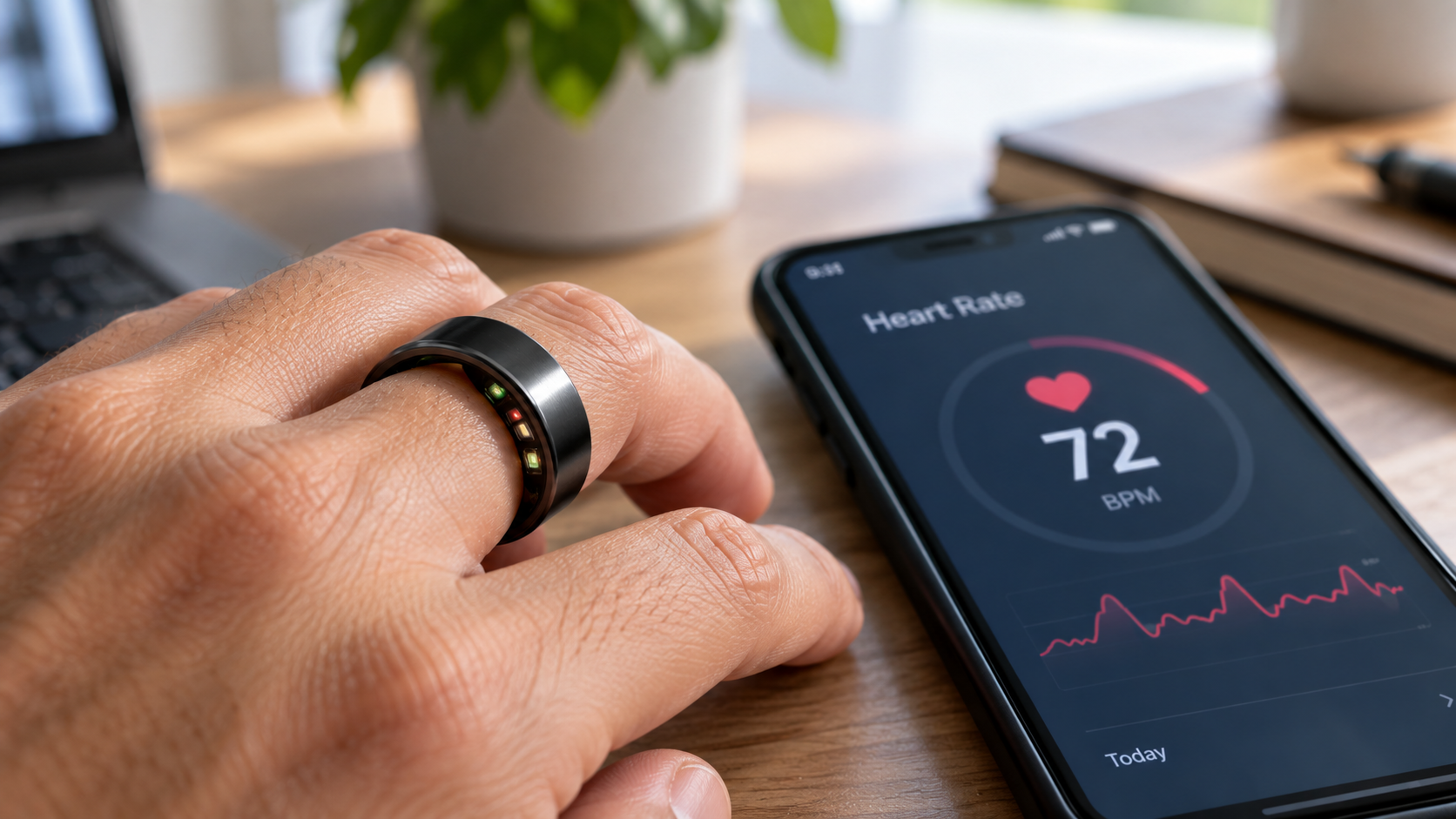
A smart ring doesn’t need to touch your heart or even electrically connect to your body to estimate how fast it is beating. How smart rings track heart rate comes down to a surprisingly simple idea: shine light into your finger, watch how that light changes, and use software to interpret the pattern.
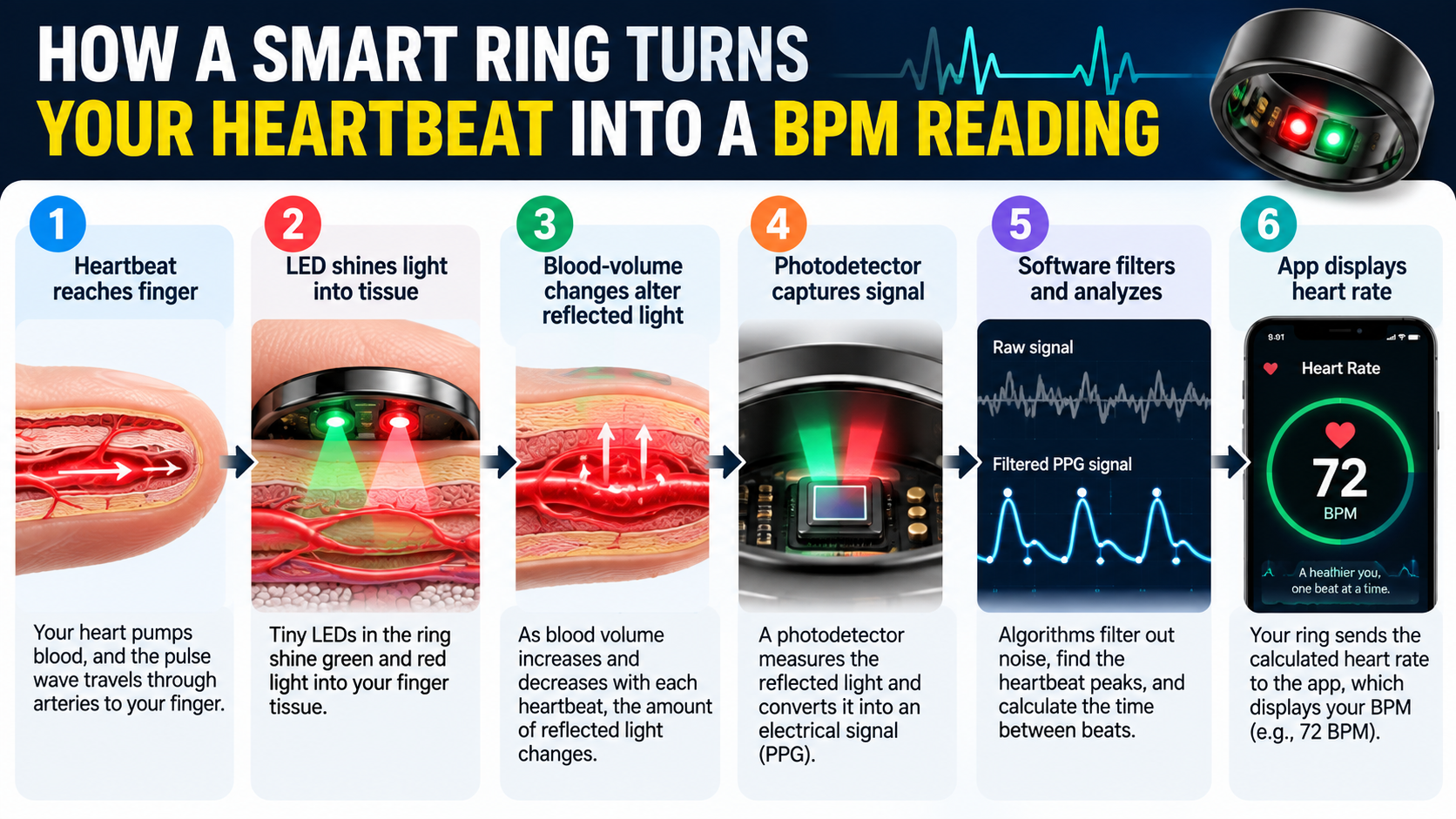
Under the tiny sensors inside a smart ring, LEDs illuminate your tissue while photodetectors measure returning light. Each heartbeat changes the amount of blood in small vessels, which changes the optical signal. The ring then processes that signal, filters out noise and estimates your pulse in beats per minute (BPM). This optical technique is called photoplethysmography, or PPG.
That sounds straightforward. The difficult part is everything that happens between the first flash of light and the number you see in the app.
The short answer: Smart rings use light to estimate your pulse
The simplest explanation is this:
A smart ring uses optical sensors to detect rhythmic changes in blood volume in your finger, then uses signal-processing algorithms to estimate your pulse rate.
The technology behind that process is PPG. In a reflective PPG system, light is emitted into the tissue and some of the light returns to a photodetector. Because the optical properties of the tissue change as blood volume changes with each pulse, the detector receives a changing signal.
So when your app says 72 BPM, the ring isn’t literally counting electrical signals from your heart. It has detected a repeating optical pattern associated with your pulse and calculated how frequently that pattern occurs.
That distinction matters.
What actually happens inside the ring when your heart beats?
Think of heart-rate tracking as a chain rather than a single measurement.
1. Your heart pumps blood
When the heart contracts, it pushes blood through the arterial system. The resulting pressure wave travels through the blood vessels.
Eventually, that pulse reaches the small vessels in your finger.
2. Blood volume in the finger changes
The amount of blood present in the tissue changes rhythmically with the pulse.
That changing blood volume affects how light behaves inside the tissue. This is the key physical event that a PPG sensor is trying to capture.
3. The ring shines light into your finger
Small LEDs inside the ring illuminate the skin.
The exact sensor configuration varies between manufacturers. Oura Ring 4, for example, uses green and infrared PPG sensors for continuous heart-rate and related measurements, alongside other sensors including a temperature sensor and accelerometer.
4. Some of that light returns to the sensor
Light doesn’t simply travel straight through your finger.
It is absorbed, scattered and reflected by tissue and blood. Changes in blood volume alter the optical signal reaching the detector.
5. The photodetector converts light changes into a signal
The photodetector measures changes in returning light intensity.
At this stage, the ring doesn’t yet have a nice, clean number such as “72 BPM.” It has a sensor signal that contains the pulse information along with noise and other physiological or environmental effects.
6. Software interprets the waveform
Algorithms process the signal, identify repeating pulse patterns and estimate the interval between them.
That interval can then be converted into beats per minute.
So the complete journey looks like this:
Heartbeat → pulse wave → blood-volume change → optical change → PPG waveform → signal processing → pulse estimate → BPM
That is the basic answer to how smart rings track heart rate.
PPG is the technology doing most of the optical work
Photoplethysmography (PPG) is a non-invasive optical technique used to detect changes in blood volume within tissue. It uses a light source and a photodetector to produce a waveform containing information related to the cardiovascular pulse.
The word looks intimidating, but the underlying concept isn’t.
Imagine shining a small flashlight at your finger while repeatedly changing the amount of blood inside the tissue. The light returning to the sensor would change as the optical environment changes.
A PPG sensor is essentially designed to measure those changes much more precisely and continuously.
Reflective PPG vs. transmission PPG
There are two common ways to arrange the light source and detector.
| PPG type | How it works | Typical example |
|---|---|---|
| Reflective PPG | Measures light returning from tissue | Smart rings and many smartwatches |
| Transmission PPG | Measures light passing through tissue | Traditional fingertip pulse oximeters |
Smart rings generally need a reflective arrangement because you can’t place a light source on one side of the finger and a detector on the opposite side while keeping the device in the form of a normal ring.
That makes sensor placement and optical design especially important.
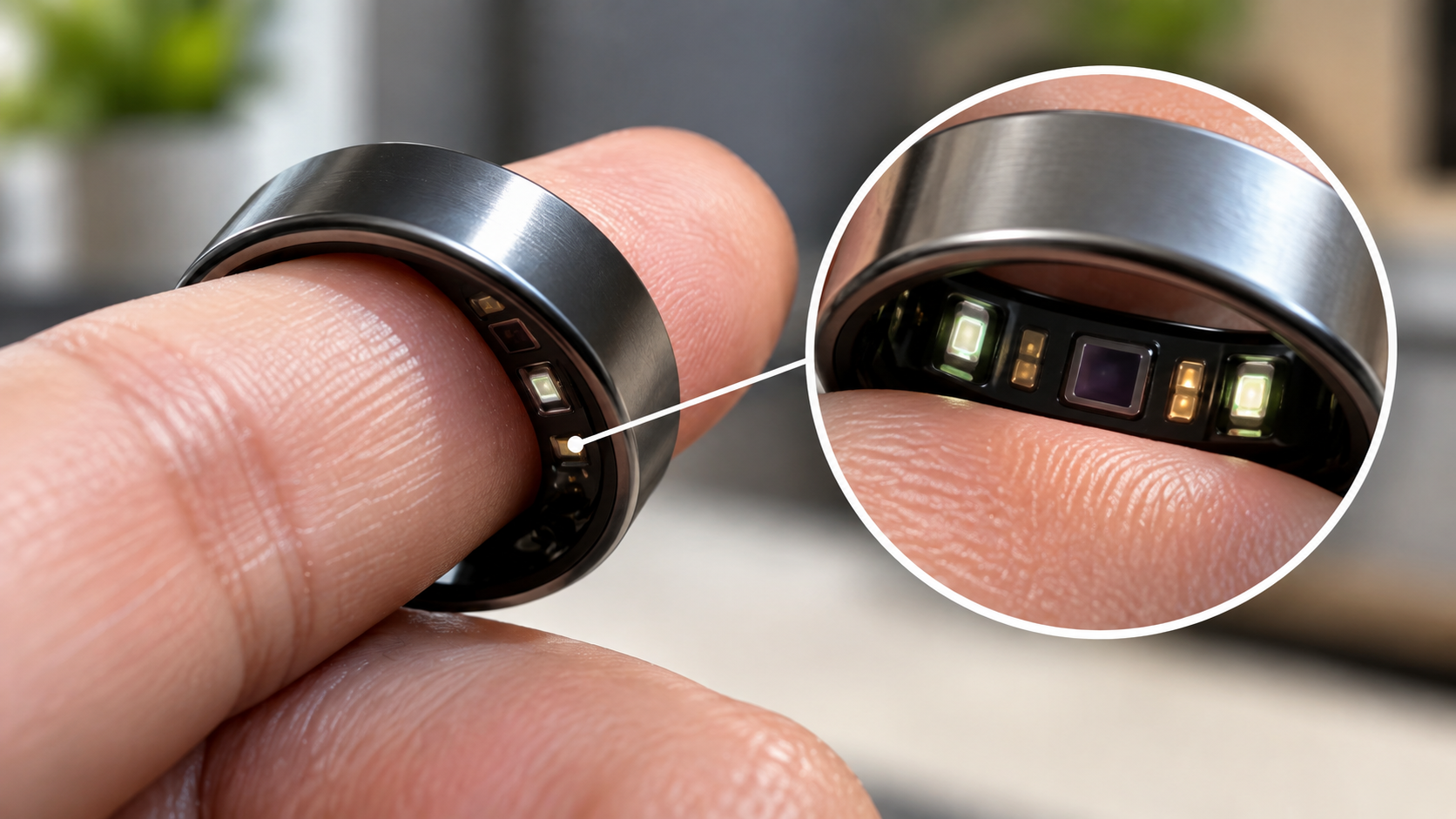
Why does a smart ring shine light into your finger?
The reason is simple: blood and surrounding tissue interact with light differently.
As blood volume changes with each pulse, the optical signal detected by the sensor changes as well. That creates the pulsatile component of the PPG waveform.
This is why one phrase deserves special attention:
Blood volume, not simply “blood flow”
You’ll often see wearable articles casually say that a PPG sensor “measures blood flow.”
That’s convenient shorthand, but it can be misleading.
For heart-rate estimation, the important signal is the pulsatile change in blood volume detected optically in the measurement site.
The ring isn’t watching individual red blood cells move past a tiny camera.
Instead, it is detecting changes in the optical properties of the tissue associated with the pulse.
That small distinction makes the explanation much more scientifically accurate.
Why smart rings use green, red and infrared light
One of the more interesting things about a smart ring is that the LEDs aren’t necessarily all doing the same job.
Different wavelengths interact with tissue differently.
Green light, for example, penetrates less deeply than red and infrared light, which can make wavelength selection an important part of PPG sensor design.
Green light is useful for heart-rate sensing
Oura states that its Live Heart Rate feature uses green LEDs and PPG technology. The company describes the process as shining light onto the skin and measuring reflected light with a photodetector.
That doesn’t mean green light is universally “the best” wavelength for every wearable.
Sensor geometry, skin contact, wavelength, detector characteristics, signal processing and the intended measurement all matter.
Red and infrared light can serve other measurements
Commercial rings can use additional wavelengths for other physiological measurements.
Oura Ring 4, for example, uses green and infrared PPG sensors for heart rate and related measurements, while red and infrared LEDs are used for blood-oxygen sensing during sleep.
The important takeaway is that the LEDs inside a smart ring are part of a broader sensing system, not simply a tiny green light that counts your heartbeat.
Why use multiple wavelengths?
Using multiple optical channels can provide additional information or alternative measurement paths.
It can also help a device deal with changing conditions.
Research on wearable PPG shows that sensor configuration including LED and photodiode positioning, spacing and the use of multiple optical signals can significantly affect signal quality.
Why is the finger such a useful place for heart-rate sensing?
A ring has one major advantage over a device that sits loosely on a larger body area: it can maintain close contact with the finger.
Finger PPG has also been extensively studied as a measurement site. Research notes that finger PPG can be more strongly influenced by blood flow in the digital arteries than upper-wrist PPG, although every measurement site has its own advantages and limitations.
The physical design of the ring matters here.
Oura recommends positioning Ring 4 so its sensors sit against the palm side of the finger for the best fit and most accurate readings.
That leads to a practical point:
A sophisticated sensor can’t compensate for every problem caused by poor contact or movement.
If the optical path keeps changing, the algorithm has a harder job.
The difficult part isn’t detecting light. It’s separating the useful signal from everything else.
This is where smart-ring heart-rate tracking becomes much more interesting.
The PPG waveform contains the cardiovascular signal the algorithm wants—but it can also contain interference.
Researchers identify motion, poor sensor contact, ambient light, temperature, respiration, peripheral perfusion and individual physiological differences among factors that can affect PPG quality.
Movement can confuse the sensor
Imagine you’re sitting still and the ring is measuring your pulse.
Now wave your hand around.
The sensor and your skin move relative to each other. The optical path changes. The resulting signal can contain components caused by movement rather than your pulse.
That is called a motion artifact.
During exercise, this becomes particularly challenging because the body is moving at the same time the heart rate is changing.
Research continues to treat motion artifact as one of the major challenges in wearable PPG.
Ring rotation matters too
A smart ring can rotate around your finger.
Even a small change in sensor orientation can alter the optical path between the LEDs, tissue and photodetector.
Recent research specifically investigates rotation-robust PPG sensor designs for smart rings, showing that orientation is not merely a cosmetic issue.
Fit matters
A ring that is too loose can move.
A ring that is poorly positioned may not place its sensors where the manufacturer intended.
And a sensor pressed against tissue under the wrong conditions can change the measurement itself.
So if two people wear the same model but get slightly different readings, that doesn’t automatically mean one device is broken.
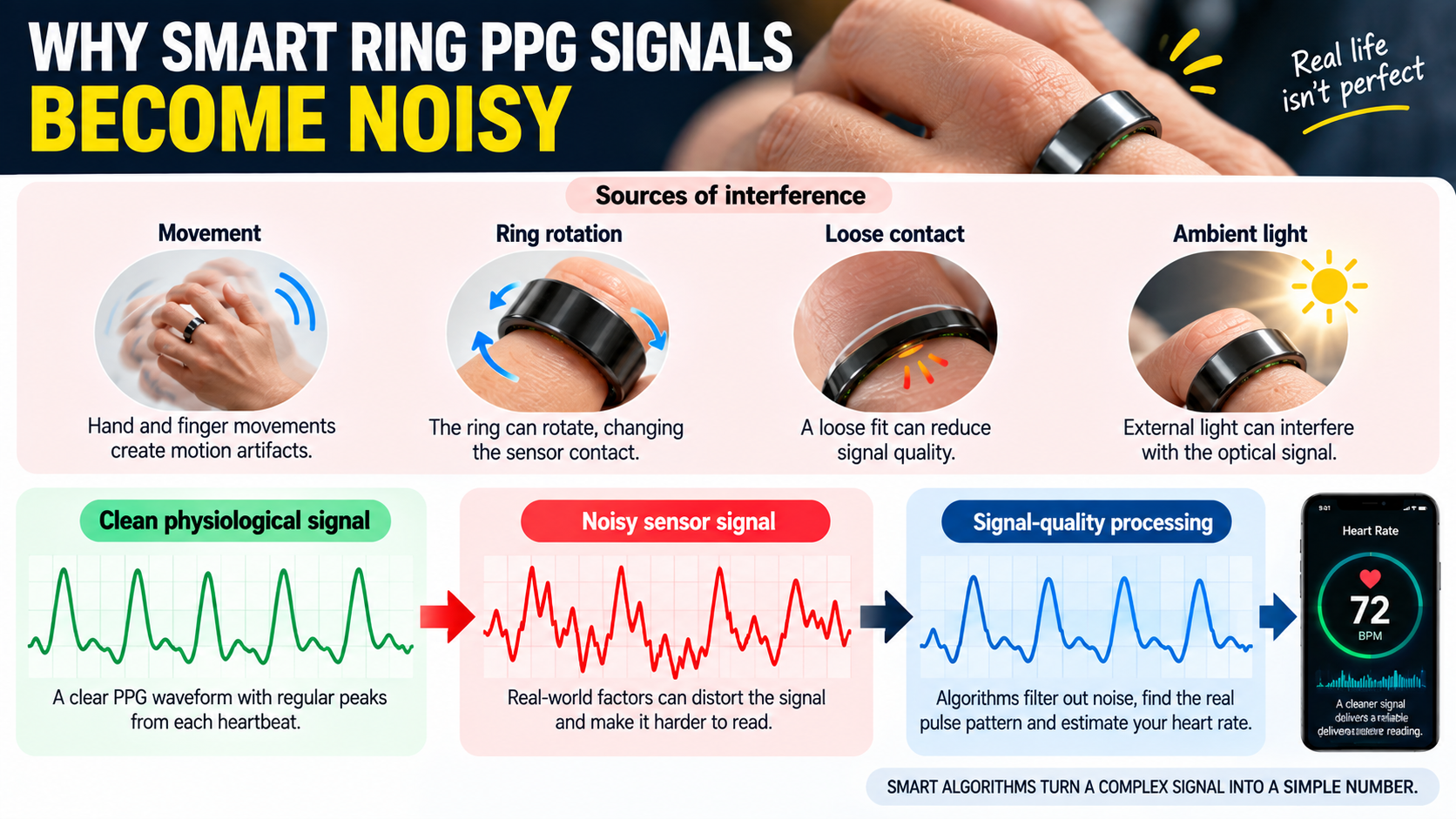
How algorithms turn a noisy PPG signal into BPM
The ring’s hardware collects the raw optical information. Software has to make sense of it.
There isn’t one universal algorithm used by every smart-ring manufacturer, but the general process can be understood in several stages.
Step 1: Capture the optical signal
The LEDs and photodetector continuously or periodically collect PPG data.
The result is a waveform that contains information about the pulse.
Step 2: Filter unwanted components
The software can use digital signal-processing techniques to reduce frequencies or patterns that are unlikely to represent the heart-rate signal.
Researchers describe approaches such as band-pass filtering, adaptive filtering and signal decomposition for wearable PPG processing.
Step 3: Identify repeating pulse patterns
The algorithm looks for features in the waveform that correspond to individual pulse cycles.
This sounds easy until the waveform contains noise.
A movement artifact can create a false peak, while a poor-quality signal can make a real peak harder to identify.
Step 4: Estimate the pulse interval
Suppose the algorithm identifies two successive pulse peaks.
The time between those peaks gives an estimate of the inter-beat interval.
If the intervals repeat at a particular frequency, the system can convert that frequency into BPM.
For example:
One pulse every 0.83 seconds ≈ 72 beats per minute.
The app doesn’t need to show the waveform to the user. It can simply display the processed result as:
72 BPM
Step 5: Assess signal quality
This step is easy to overlook.
A wearable system can assess whether a section of PPG data is reliable enough to use.
Research describes approaches including waveform-shape analysis, perfusion measures, template matching and machine-learning techniques for assessing PPG signal quality.
Step 6: Combine information when appropriate
Some wearable systems can use additional sensor signals to help identify motion or improve the interpretation of PPG.
That brings us to the other sensors inside a smart ring.
Your smart ring may use more than the optical sensor
A heart-rate system doesn’t necessarily work from PPG alone.
For example, Oura Ring 4 includes an accelerometer that tracks movement and a digital temperature sensor alongside its optical sensors.
Why would movement information matter?
Because the algorithm can potentially distinguish:
“This change probably came from movement.”
from:
“This repeating pattern looks more like a pulse.”
Research on wearable PPG describes the use of accelerometers and gyroscopes as reference signals for motion-artifact removal.
This is one reason it is misleading to think of a smart ring as simply:
LED + detector = heart rate
The real system is closer to:
Optical sensors + supporting sensors + signal processing + quality assessment + algorithms = heart-rate estimate
That distinction explains why software is such a large part of modern wearable sensing.
What does “72 BPM” actually mean?
If your ring shows 72 BPM, it means the system has estimated that your pulse is occurring at a rate equivalent to approximately 72 beats per minute.
It doesn’t necessarily mean the ring captured 72 perfect heartbeats and counted them one by one like a mechanical counter.
Wearable systems process sensor data over time and estimate the underlying pulse rate.
That’s especially important when you look at a graph.
A smooth heart-rate curve in an app is usually the result of processed sensor data, not a direct display of the raw optical signal.
This is also why the number can change when the algorithm receives better or worse signal-quality information.
Smart ring heart rate vs. ECG: what’s the difference?
This is one of the most important distinctions in the entire topic.
PPG and ECG can both provide heart-rate information, but they measure different physiological signals.
| Measurement | PPG-based smart ring | ECG |
|---|---|---|
| Primary signal | Optical changes associated with blood-volume changes | Electrical activity of the heart |
| Main hardware | LEDs + photodetector | Electrodes |
| Measurement approach | Optical | Electrical |
| Common wearable advantage | Small and suitable for continuous monitoring | Directly captures cardiac electrical activity |
| Measures the heart’s electrical signal? | No | Yes |
| Typical use | Continuous wellness/physiological tracking | Cardiac electrical assessment |
PPG is useful because it can be made small, comfortable and suitable for continuous wearable monitoring. But it isn’t simply a miniature ECG.
That difference matters if you’re interpreting health data.
How accurate are smart-ring heart-rate readings?
There isn’t one accuracy number that applies to every smart ring.
A better question is:
How well does this particular device measure heart rate under this particular condition?
A ring may perform very well when you’re sitting still or sleeping, while movement-heavy exercise presents a harder sensing problem.
Research on wearable PPG repeatedly identifies motion as a major source of error, and recent work on ring-based sensing continues to examine performance under controlled, everyday and motion-intensive conditions.
That means claims such as:
“Smart rings are 99% accurate.”
should be treated cautiously unless they refer to a specific device, measurement protocol and comparison method.
Conditions that can affect readings
| Condition | Why it can matter |
|---|---|
| Sitting still | Usually provides a relatively stable measurement environment |
| Sleeping | Less voluntary movement can make optical sensing easier |
| Walking | Hand movement can introduce artifacts |
| Running | Strong movement makes PPG processing more difficult |
| Loose ring | Changes sensor-to-skin contact |
| Ring rotation | Changes the optical measurement path |
| Cold conditions | Peripheral circulation can change |
| Bright ambient light | Can interfere with optical sensing |
| Individual physiology | Tissue and vascular characteristics vary |
This doesn’t make smart-ring heart-rate tracking useless.
It means the number should be understood as a sensor-derived estimate whose quality depends on the measurement conditions.
Why your smart ring can occasionally show a strange heart-rate number
If you see an unexpected spike or drop, there are several possible explanations.
The ring moved
The sensor may have picked up motion-related changes.
The ring rotated
The optical path may have changed.
Your hand was moving
The PPG waveform can become harder to interpret during activity.
The sensor had poor contact
A loose or poorly positioned ring can reduce signal quality.
Your peripheral circulation changed
PPG depends on optical measurements in peripheral tissue, so physiological changes can affect the signal.
The algorithm rejected or reinterpreted noisy data
A wearable may update an estimate as better-quality information becomes available.
None of these automatically means the device is defective.
At the same time, repeated unusual readings shouldn’t simply be dismissed as “sensor error,” particularly when they coincide with symptoms or other health concerns. A consumer wearable isn’t a substitute for appropriate medical evaluation.
What happens to your heart-rate data after the ring measures it?
The sensor is only the beginning.
A simplified data pipeline looks like this:
LEDs + photodetector
↓
Raw optical signal
↓
Signal filtering
↓
Motion/noise assessment
↓
Pulse detection
↓
Heart-rate estimation
↓
Phone app
↓
Trends and insights
The app can then turn individual measurements into longer-term information such as resting-heart-rate trends or changes across different periods.
But remember: the app’s polished graph is several processing steps removed from the raw optical signal.
That is why understanding the underlying technology is useful. It helps you interpret what the number represents rather than treating every displayed value as a perfect direct measurement.
Pros and Cons of Optical Heart-Rate Tracking in Smart Rings
Pros
- Small and non-invasive: Optical sensors can fit inside a compact ring.
- Suitable for continuous monitoring: PPG can collect physiological data throughout the day and night.
- Comfortable for passive tracking: There are no external electrodes that need to remain attached to the skin.
- Works well with other sensors: PPG can be combined with movement, temperature and additional optical measurements.
- Finger-based sensing can provide a useful signal: The finger is an established PPG measurement site.
Cons
- Movement can introduce artifacts: Exercise and hand movement can make the optical signal harder to interpret.
- Fit and orientation matter: Ring position affects the optical path and sensor contact.
- Ambient conditions can interfere: External light and physiological changes can affect PPG.
- PPG isn’t ECG: It does not directly measure the heart’s electrical activity.
- Performance varies by device and situation: A result from one ring cannot automatically be generalized to every smart ring.
- Consumer readings are not automatically medical diagnoses: Wearable data should be interpreted within the limits of the device and the measurement method.
Research reviews consistently identify motion, contact, ambient light and physiological variation as important limitations of wearable PPG.
The bigger picture: a smart ring is really a tiny signal-processing system
The impressive part of a smart ring isn’t just the LED.
It is the entire chain working together.
A tiny device has to:
- Put light into tissue.
- Capture the returning optical signal.
- Detect the pulse-related component.
- Deal with movement and other interference.
- Judge whether the signal is good enough.
- Estimate pulse intervals.
- Convert those intervals into BPM.
- Send the processed information to an app.
- Turn individual readings into useful trends.
That’s a lot of engineering packed into something that looks like a piece of jewelry.
And it explains why the answer to how smart rings track heart rate is much more interesting than “they use a sensor.”
The sensor collects the evidence. The algorithms make sense of it.
Frequently Asked Questions
How do smart rings measure heart rate?
Smart rings commonly use photoplethysmography (PPG). LEDs shine light into the finger, a photodetector measures changes in returning light associated with pulsatile blood-volume changes, and software processes the waveform to estimate pulse rate in BPM.
Do smart rings actually measure your heartbeat?
They generally don’t directly measure the heart’s electrical activity when using PPG. Instead, they measure an optical signal associated with the pulse in peripheral tissue and use it to estimate heart rate.
Why do smart rings use green light?
Green light is commonly used in wearable PPG because wavelength affects how deeply light interacts with tissue and how the resulting signal behaves. Some commercial rings also use infrared and other wavelengths for additional measurements.
Can a smart ring measure heart rate while sleeping?
Yes. Some smart rings are designed to measure heart rate continuously or throughout sleep. Oura, for example, states that Ring 4 uses green and infrared PPG sensors to measure heart rate continuously.
Sleep can also provide a relatively stable measurement environment because there is generally less voluntary movement than during exercise, although individual conditions and sensor quality still matter.
Are smart-ring heart-rate readings accurate?
They can be useful, but accuracy depends on the specific device and measurement conditions. Motion, ring position, sensor contact, ambient light and physiological factors can affect PPG measurements. There is no single accuracy percentage that applies to every smart ring in every situation.
Is a smart-ring heart-rate reading the same as an ECG?
No. A PPG-based smart ring measures optical changes associated with pulsatile blood volume, while an ECG records electrical activity from the heart. Both can provide heart-rate information, but they are measuring different physiological signals.
Conclusion
The next time your smart ring displays a heart rate, remember that the number didn’t come from a tiny machine listening directly to your heart.
It started with light.
The ring illuminates your finger, detects changes in the returning light, captures a PPG waveform and uses signal-processing algorithms to separate the pulse-related information from noise. Other sensors, such as accelerometers and temperature sensors, can provide additional context depending on the device.
The result is a simple number—72 BPM, for example—but there’s a surprisingly sophisticated process behind it.
And that’s the key to understanding how smart rings track heart rate: they don’t need to measure the heart directly to learn something useful about its rhythm. They measure the pulse’s optical signature in your finger and let hardware and software turn that signal into something you can understand.
If you’re evaluating a smart ring, the more useful question isn’t simply “Does it have a heart-rate sensor?” It’s how well its sensors, placement, signal processing and algorithms work together under the conditions in which you actually plan to wear it.