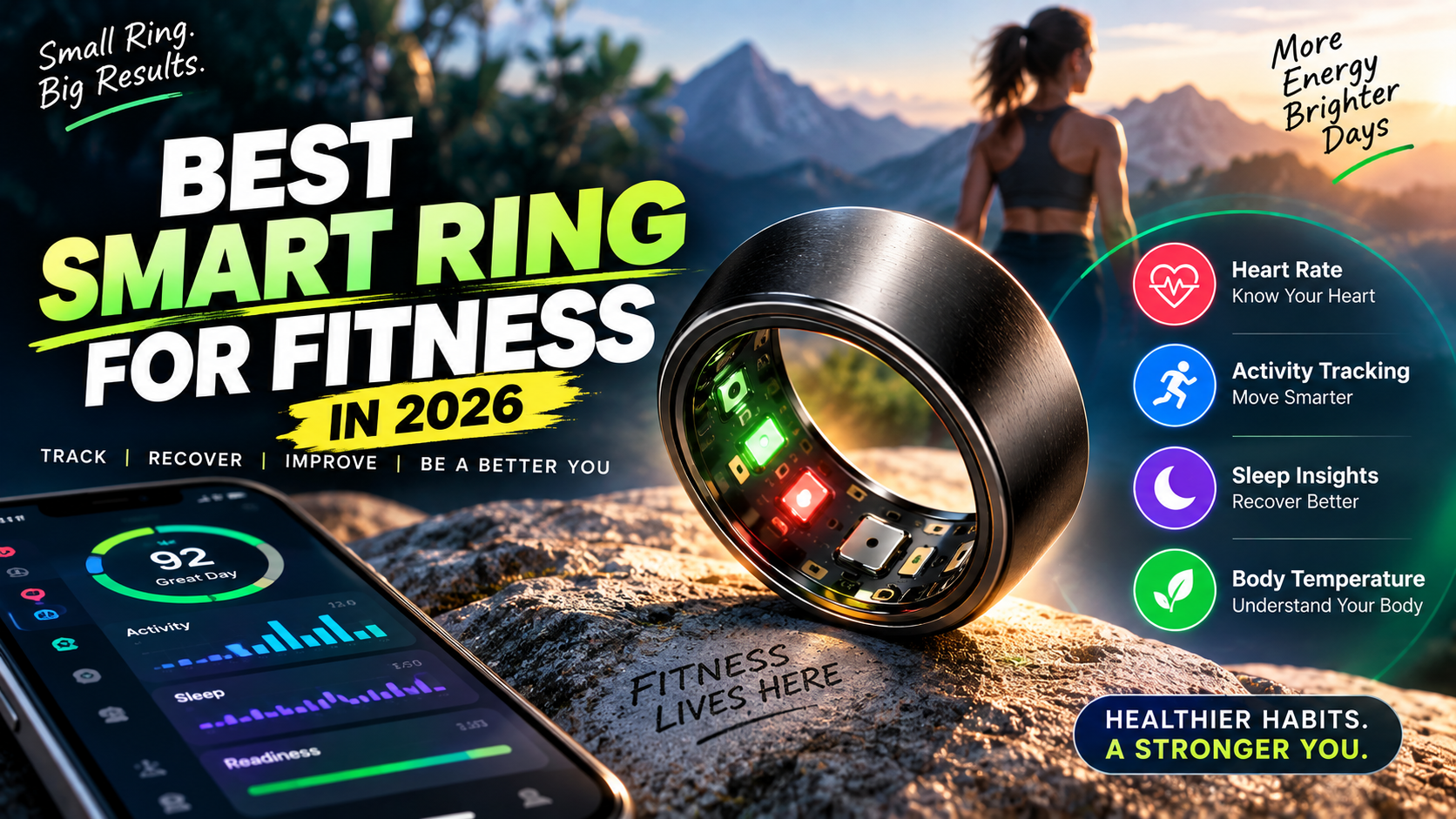
You’ve probably already used a smartwatch or fitness tracker to monitor steps, workouts, heart rate, or sleep, but wearing a device on your wrist 24/7 isn’t ideal for everyone. Smart rings now offer a smaller way to monitor fitness, recovery, sleep, and health, but each model focuses on different strengths. In this guide, we’ll compare the best smart rings for fitness in 2026 and explain which one makes the most sense for workouts, recovery, runners, gym users, and subscription-free tracking.
Key Takeaways
- Fitness smart rings are compact wearables that use sensors to track activity, biometrics, sleep, recovery, and other health-related metrics.
- Fitness tracking capabilities vary between smart rings, with some emphasizing recovery and wellness while others offer stronger workout and ecosystem features.
- Heart rate, sleep, recovery, battery life, comfort, compatibility, and subscription costs are important factors when comparing fitness smart rings.
- Oura Ring 5, Samsung Galaxy Ring, RingConn Gen 2, RingConn Gen 2 Air, and Ultrahuman Ring AIR differ significantly in features, software ecosystems, battery life, and subscription requirements.
- The best smart ring for fitness depends on whether you prioritize workouts, recovery, sleep, health insights, ecosystem integration, or subscription-free ownership.
- Smart rings can complement fitness apps and smartwatches by providing continuous data that is difficult to capture during sleep and everyday activities.
- Real-world fitness goals and total ownership cost matter more than simply choosing the ring with the largest number of sensors.
What Is a Smart Ring for Fitness and How Does It Work?
A fitness smart ring is a wearable device that uses miniature sensors to track metrics such as activity, heart rate, sleep, recovery, and other biometric signals throughout the day. Unlike a smartwatch, a smart ring usually has no display, notifications, or large interface, allowing it to focus on passive tracking.
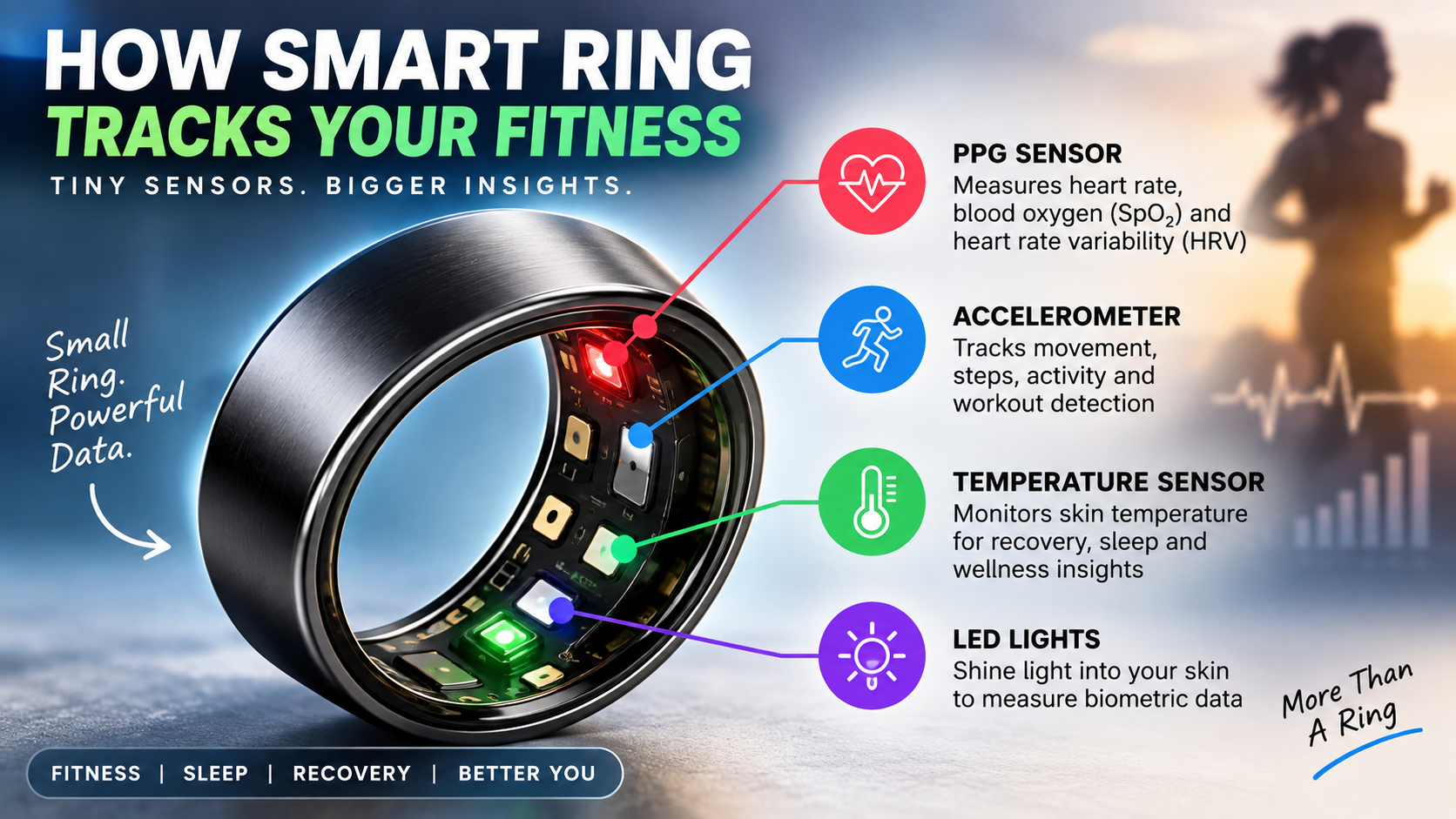
Moreover, most modern smart rings combine photoplethysmography (PPG) sensors, accelerometers, and temperature sensors to collect different types of data. For example, an accelerometer can detect movement and activity while optical sensors can measure heart-rate signals.
At the same time, smart rings are generally better suited to continuous health, sleep, and recovery monitoring than replacing a dedicated sports watch for advanced training. A runner who needs detailed maps, navigation, pace alerts, and extensive workout controls may still prefer a Garmin, Apple Watch, or another sports-focused wearable.
For example, Oura Ring 5 uses multiple sensing pathways, temperature sensing, and an accelerometer to collect continuous data, while Samsung Galaxy Ring combines an accelerometer, optical biosignal sensor, and skin-temperature sensor.
How Does a Smart Ring Track Fitness?
Smart rings track fitness by combining movement, heart-rate, temperature, and other biometric signals into activity and recovery insights. The ring collects raw sensor data and the companion app turns that information into understandable metrics.
For example, a fitness ring can detect walking, running, changes in heart rate, daily activity, sleep duration, and recovery patterns. Some models can also estimate metrics such as VO₂ Max or provide readiness and energy scores.
Furthermore, continuous wear is one of the biggest advantages of a smart ring. You can wear a ring while sleeping, working, walking, exercising, or relaxing without dealing with a screen on your wrist.
Smart Ring vs Fitness Tracker: What’s the Difference?
A smart ring differs from a conventional fitness tracker mainly through its form factor, screen-free design, and emphasis on continuous passive tracking. Fitness bands and smartwatches generally provide more real-time workout controls, while smart rings prioritize comfort and background monitoring.
For example, a smartwatch can display your running pace directly on your wrist, whereas a smart ring may depend on your phone and companion app for detailed workout information.
Therefore, a smart ring is especially attractive if you want sleep and recovery tracking without wearing a screen-based device overnight.
Why Is Choosing the Best Smart Ring for Fitness Important?
Choosing the best smart ring for fitness matters because different rings prioritize different aspects of training, recovery, sleep, and health tracking. A ring that is excellent for sleep may not be the best choice for someone who wants detailed workout feedback.
For example, Oura emphasizes health insights, sleep, activity, and readiness, while Samsung focuses heavily on integration with Samsung Health. RingConn emphasizes long battery life and subscription-free tracking, while Ultrahuman positions Ring AIR around continuous health and fitness insights without a recurring membership.
Why Fitness Tracking Alone Isn’t Enough
Fitness performance depends on both training and recovery, so a useful fitness ring should help you understand what happens outside your workout. Sleep, resting heart rate, HRV trends, and daily activity can provide context for how your body responds to training.
For example, two people may complete the same gym session, but one may have slept poorly while the other recovered well. A recovery-focused wearable can help put the workout into a broader context.
Moreover, a smart ring should be evaluated as a complete system rather than just a collection of sensors. The app, algorithms, battery, comfort, ecosystem, and recurring costs can be just as important as the hardware.
Why Comfort Matters for Fitness Tracking
Comfort matters because the most useful smart-ring data often comes from wearing the device consistently. A ring that feels uncomfortable during sleep or exercise may spend more time sitting on a charger than collecting useful information.
For example, Oura Ring 5 is designed to be 40% smaller in volume than Oura Ring 4, while Samsung Galaxy Ring weighs approximately 2.3–3.3 grams depending on size.
As a result, the best fitness ring is often the one you can comfortably wear every day, not necessarily the one with the longest feature list.
What Features Should You Look for in the Best Smart Ring for Fitness?
The most important smart-ring features for fitness are activity tracking, heart-rate monitoring, recovery metrics, sleep tracking, comfort, battery life, compatibility, app quality, and total ownership cost. These criteria provide a better buying framework than comparing sensor counts alone.
1. Workout and Activity Tracking
Workout tracking measures physical activity so you can understand how much, how often, and how intensely you move. Basic tracking can include steps, distance, calories, activity duration, and automatically detected workouts.
For example, Samsung Galaxy Ring can automatically recognize certain activities and record exercise time, steps, and calories in Samsung Health.
Meanwhile, Oura’s Automatic Activity Detection can recognize more than 40 activities, including lower-motion activities such as strength training, yoga, and indoor cycling following its July 2026 update.
2. Heart-Rate Monitoring
Heart-rate monitoring helps you understand exercise intensity and provides additional context for recovery and cardiovascular trends. A good fitness ring should provide useful heart-rate information during both daily activity and workouts.
For example, Oura supports activity heart rate and heart-rate zones, while Samsung Galaxy Ring continuously monitors heart rate and can automatically track walks and runs.
That being said, heart-rate accuracy should not be confused with medical-grade diagnosis. Consumer smart rings are designed primarily for wellness and fitness applications.
3. Sleep and Recovery Tracking
Sleep and recovery tracking help you understand whether your body is prepared for another demanding training session. Smart rings are particularly useful here because they are small enough to wear overnight.
For example, Oura provides sleep, activity, readiness, stress, and heart-health insights, while RingConn tracks sleep stages, heart activity, temperature, and related trends.
4. Battery Life
Battery life determines how continuously you can collect fitness and recovery data without interrupting wear. Longer battery life generally makes overnight and all-day tracking easier.
Current manufacturer specifications show a wide range: Oura Ring 5 typically provides 6–9 days, Galaxy Ring provides up to 7 days depending on size and use, RingConn Gen 2 provides up to 10–12 days, RingConn Gen 2 Air provides up to 10 days, and Ultrahuman Ring AIR provides roughly 4–6 days.
5. Subscription Cost
Subscription cost is important because the cheapest ring to purchase may not be the cheapest ring to own. A recurring fee can significantly change the long-term value of a smart ring.
For example, Oura Membership currently costs $5.99 per month or $69.99 per year in the United States, while RingConn and Ultrahuman state that their core ring data does not require a recurring subscription.
What Is the Best Smart Ring for Fitness in 2026?
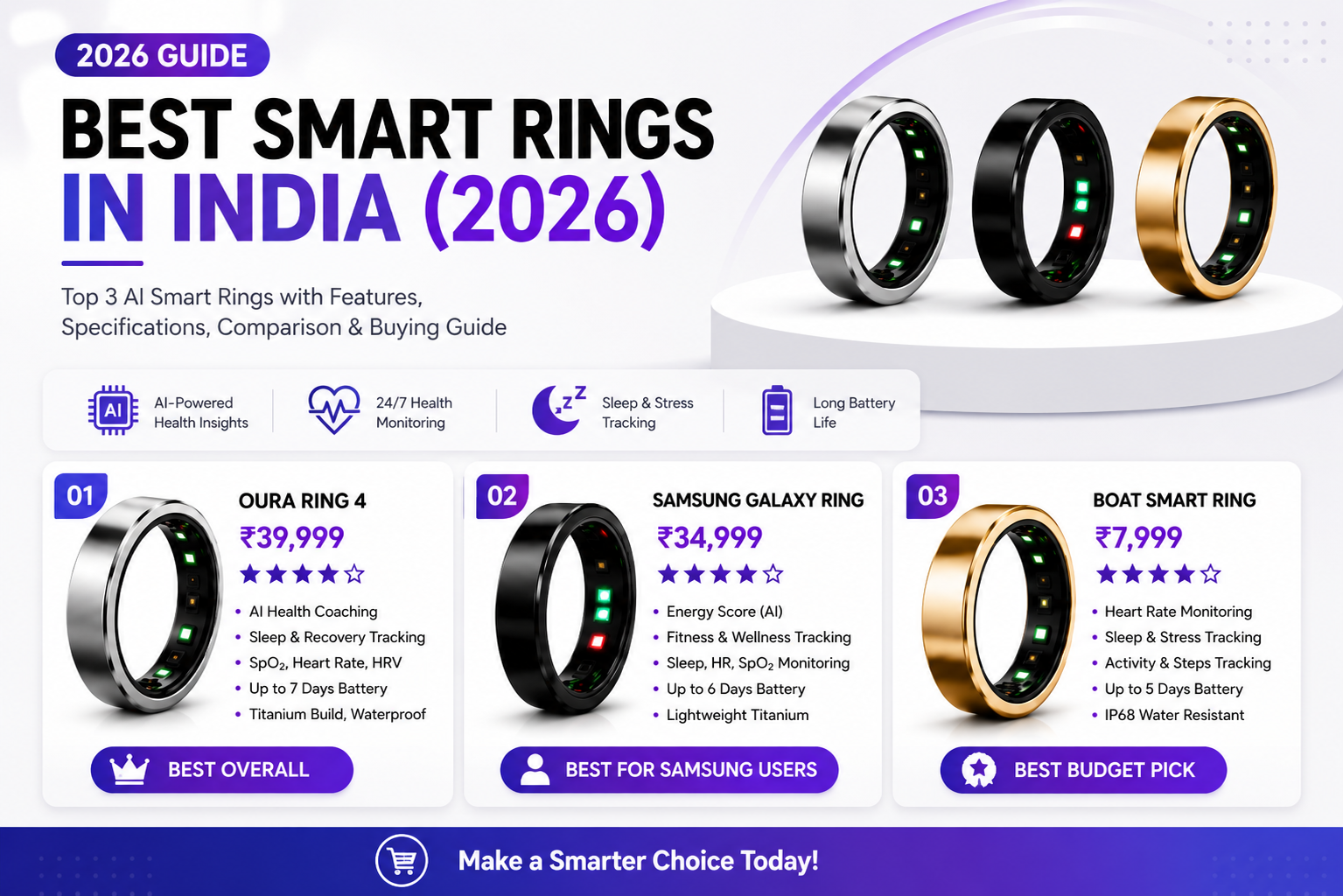
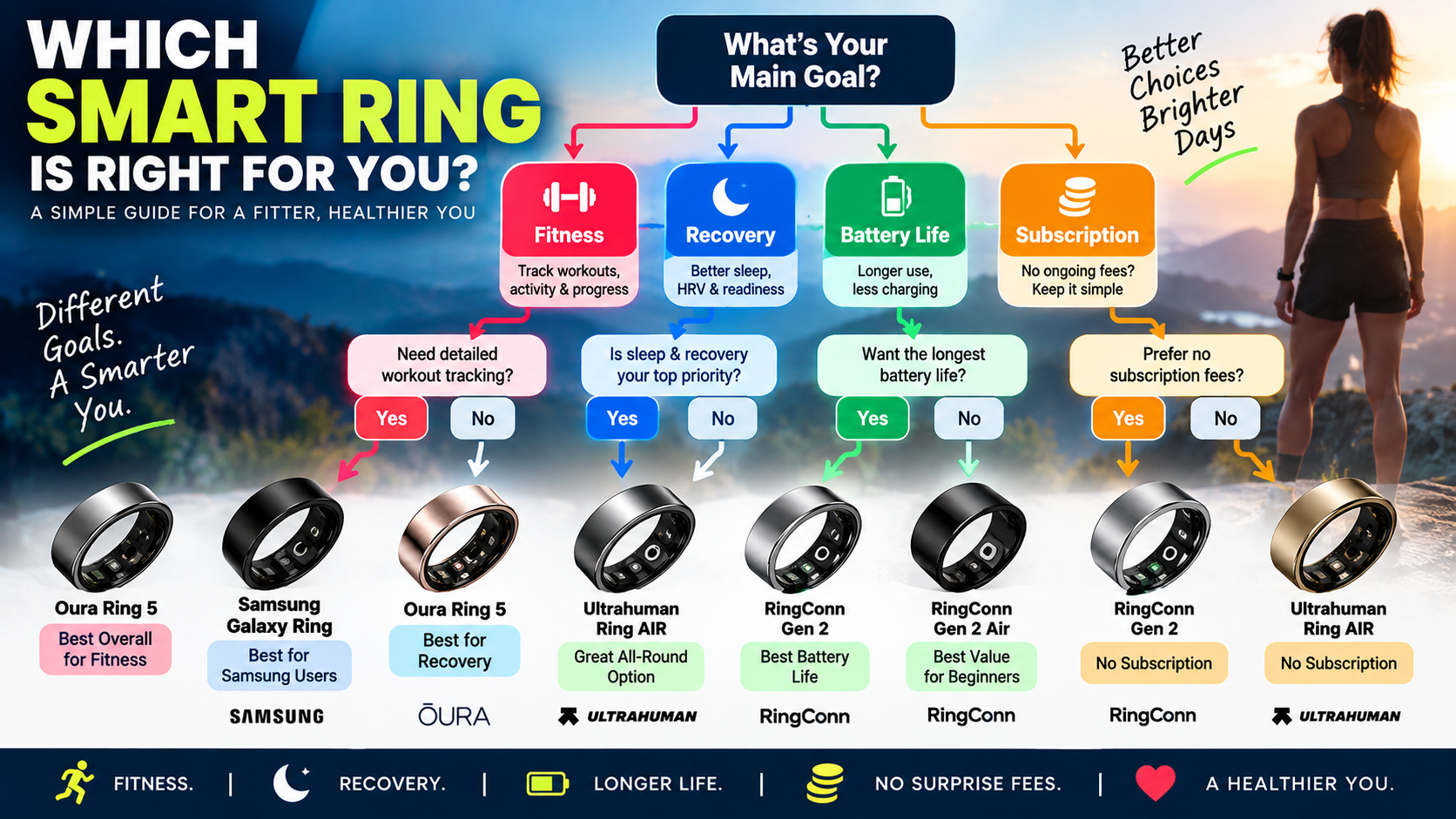
The best smart ring for fitness in 2026 depends on your training priorities, but Oura Ring 5 is the strongest overall choice for users who prioritize comprehensive health, recovery, and fitness insights. RingConn Gen 2 is particularly attractive for subscription-free ownership and long battery life, Samsung Galaxy Ring is compelling for Samsung users, and Ultrahuman Ring AIR is a strong option for users focused on fitness and metabolic insights.
Current 2026 testing guides also place Oura Ring 5 at or near the top of the overall smart-ring category, while identifying RingConn, Ultrahuman, and Samsung as strong alternatives for different needs.
1. Oura Ring 5 – Best Overall for Fitness and Recovery
Oura Ring 5 is the best overall smart ring for fitness if you want a combination of activity tracking, sleep analysis, recovery insights, heart-rate data, and a mature health-focused app. The fifth-generation ring launched in May 2026 with a smaller design and updated sensing architecture.
Moreover, Oura Ring 5 provides 50+ health metrics, according to Oura, and supports sleep, activity, fitness readiness, stress, heart health, and other health categories.
Furthermore, Oura has expanded its workout functionality. Its Live Activity Tracking feature can provide real-time pace and distance using phone GPS, while compatible third-party heart-rate monitors can provide live heart-rate data.
Pros:
- Excellent health and recovery ecosystem
- Strong sleep-tracking focus
- Automatic activity detection
- Activity heart-rate and heart-rate-zone features
- iOS and Android support
- More than 40 third-party app integrations
- Newer Ring 5 design is significantly smaller
Cons:
- Requires a paid membership for the full experience
- Not a replacement for a dedicated sports watch
- Phone-based GPS is useful for some workout functions
- Premium pricing can increase total ownership cost
2. RingConn Gen 2 – Best for Long Battery Life Without a Subscription
RingConn Gen 2 is one of the best smart rings for fitness if you want long battery life, lightweight hardware, and core health tracking without a recurring subscription. RingConn lists up to 10–12 days of battery life and a 2–3 gram weight depending on size.
Additionally, RingConn Gen 2 uses PPG sensors, an accelerometer, SpO₂ sensing, and temperature sensing for its health-tracking system. It also has IP68 water resistance rated to 100 meters/328 feet.
For example, someone who travels frequently or dislikes charging can benefit from the ring’s long battery life. That makes it particularly attractive for continuous sleep and recovery tracking.
Pros:
- 10–12-day claimed battery life
- No recurring subscription
- Lightweight 2–3 gram design
- Sleep and health tracking
- IP68 water resistance
- Charging case extends overall usability
Cons:
- App experience may feel more data-heavy than coaching-focused
- Workout ecosystem is less extensive than some competitors
- Advanced sports-watch functionality is limited
3. Samsung Galaxy Ring – Best for Samsung Users
Samsung Galaxy Ring is one of the best smart rings for fitness for people already invested in the Samsung Galaxy ecosystem. The ring synchronizes tracked information with Samsung Health and can automatically recognize activities such as walking and running.
Moreover, Galaxy Ring uses an accelerometer, optical biosignal sensor, and skin-temperature sensor. Samsung lists up to seven days of battery life for certain larger sizes, while actual battery life varies by ring size and usage.
Importantly, Samsung states that Galaxy Ring requires an Android 11 or later smartphone and the Galaxy Wearable and Samsung Health apps.
Pros:
- Excellent Samsung Health integration
- Automatic activity tracking
- Heart-rate monitoring
- Sleep and activity insights
- Lightweight titanium construction
- No standard recurring ring-data subscription
- Up to seven days of battery life depending on size
Cons:
- Best experience is within Samsung’s ecosystem
- Android requirement limits iPhone users
- Less suitable for people wanting advanced sports-watch features
- Some functionality depends on Samsung devices and apps
4. Ultrahuman Ring AIR – Best Subscription-Free Fitness Option
Ultrahuman Ring AIR is a strong smart ring for fitness users who want detailed health and recovery tracking without a recurring subscription for core ring data. Ultrahuman states that Ring AIR provides movement and workout tracking, sleep tracking, HRV-based recovery information, stress monitoring, and VO₂ Max-related features.
Furthermore, Ring AIR weighs as little as 2.4 grams and provides approximately 4–6 days of battery life depending on usage and size. Ultrahuman explicitly states that there are no recurring subscription fees for accessing the ring’s data.
Pros:
- No mandatory recurring subscription
- Lightweight design
- Strong sleep and recovery focus
- HRV tracking
- Workout and movement tracking
- VO₂ Max-related fitness insights
- Available for users who want a broader health-performance ecosystem
Cons:
- Shorter battery life than RingConn
- Some advanced ecosystem features may vary
- Not a full replacement for a sports watch
- App and insight style may appeal more to data-focused users
5. RingConn Gen 2 Air – Best Value Smart Ring for Beginners
RingConn Gen 2 Air is one of the best smart rings for beginners who want essential health and fitness tracking without paying for a recurring subscription. RingConn lists a $199 price point, up to 10 days of battery life, and a 2.5–4 gram weight depending on size.
Additionally, the Gen 2 Air includes PPG, temperature, and three-axis accelerometer sensors and provides sleep, activity, stress, and exercise-related tracking.
Pros:
- Lower entry price
- No subscription
- Up to 10-day battery life
- Lightweight design
- Sleep and activity tracking
- IP68 water resistance
- Suitable for beginners
Cons:
- Fewer advanced features than higher-end models
- Less established software ecosystem than Oura
- Not designed as a dedicated performance sports watch
- App experience may be less coaching-oriented
How Do the Best Fitness Smart Rings Compare?
The best fitness smart rings differ most in software experience, workout functionality, battery life, ecosystem integration, and subscription requirements. A side-by-side comparison makes these trade-offs easier to understand.
| Smart Ring | Best For | Battery | Subscription | Fitness Strength | Ecosystem |
|---|---|---|---|---|---|
| Oura Ring 5 | Overall fitness + recovery | 6–9 days | Yes | Excellent recovery and activity insights | iOS + Android |
| RingConn Gen 2 | Battery + no subscription | 10–12 days | No | Strong health/activity tracking | iOS + Android |
| Samsung Galaxy Ring | Samsung users | Up to 7 days* | No standard ring-data fee | Strong Samsung Health integration | Android/Samsung |
| Ultrahuman Ring AIR | Subscription-free fitness | 4–6 days | No mandatory fee | Strong fitness/recovery insights | iOS + Android |
| RingConn Gen 2 Air | Value | Up to 10 days | No | Essential fitness and health tracking | iOS + Android |
*Battery life varies by ring size and usage. Manufacturer specifications should be checked before purchase.
Which Smart Ring Has the Best Workout Tracking?
Oura Ring 5 has one of the strongest overall workout ecosystems among smart rings, especially for users who want workout data combined with sleep and recovery insights. Oura’s Automatic Activity Detection recognizes a broad range of activities, while its newer Live Activity Tracking adds real-time workout information through the app.
However, a smart ring is still not the ideal tool for every serious athlete. Runners training by pace, cyclists requiring navigation, or triathletes managing structured sessions may benefit more from a dedicated sports watch.
Which Smart Ring Is Best for Heart-Rate and Activity Tracking?
Oura Ring 5 is a strong choice for users who prioritize continuous heart-rate and activity insights, while Samsung Galaxy Ring is particularly compelling for people already using Samsung Health. Oura provides activity heart rate, heart-rate zones, and 24-hour heart-rate information, while Galaxy Ring continuously monitors heart rate and supports automatic activity detection.
For example, a gym user may use the ring to review heart-rate trends after training while also checking sleep and recovery data the following morning.
Which Smart Ring Is Best for Sleep and Recovery?
Oura Ring 5 is the strongest choice for users who place sleep and recovery at the center of their fitness routine. Oura’s platform combines sleep, activity, readiness, heart-rate, HRV, and other health signals into longer-term insights.
For example, someone training four days a week can use sleep and recovery trends to understand whether their daily routine is supporting consistent training.
Which Smart Ring Is Best for Different Fitness Goals?
The right fitness smart ring depends on the specific activity, training style, phone ecosystem, and willingness to pay a subscription. Instead of selecting one universal winner, match the device to the way you actually exercise.
| Fitness Goal | Recommended Ring | Why |
|---|---|---|
| Overall fitness + recovery | Oura Ring 5 | Strong health and recovery ecosystem |
| Sleep-focused fitness | Oura Ring 5 | Deep sleep and recovery insights |
| Samsung ecosystem | Galaxy Ring | Samsung Health integration |
| No subscription | RingConn Gen 2 | Long battery and no recurring fee |
| Subscription-free fitness | Ultrahuman Ring AIR | Fitness/recovery-focused insights |
| Long battery life | RingConn Gen 2 | Up to 10–12 days |
| Beginner/value | RingConn Gen 2 Air | Lower-cost entry point |
| Serious running | Smart ring + sports watch | Better pace, GPS and workout controls |
What Is the Best Smart Ring for Gym Workouts?
Oura Ring 5 is a strong choice for gym users who want strength-training activity recognition plus recovery and sleep information. Oura’s 2026 activity-detection update specifically improved recognition for lower-motion activities such as strength training.
However, a smart ring should complement rather than replace a dedicated workout display if you need exercise-by-exercise controls. For example, someone performing a structured strength program may still want a smartwatch or phone to record sets, reps, timers, or exercise instructions.
What Is the Best Smart Ring for Runners?
Oura Ring 5 is a strong choice for runners who care about recovery, while a dedicated sports watch remains better for runners who need advanced live training data. Oura’s Live Activity Tracking can display pace and distance using phone GPS, and compatible heart-rate monitors can provide live heart-rate data.
For example, a casual runner can use a ring for daily recovery and sleep while using a Garmin or Apple Watch for detailed running sessions.
What Is the Best Smart Ring Without a Subscription?
RingConn Gen 2 is one of the strongest choices for users who want a subscription-free smart ring with long battery life. RingConn lists up to 10–12 days of battery life and no subscription requirement for its Gen 2 model.
Similarly, Ultrahuman Ring AIR provides core ring-data access without recurring subscription fees, making it another strong option for buyers who prefer a one-time hardware purchase.
What Is the Best Smart Ring for Android Users?
The best smart ring for Android depends on the phone ecosystem, with Samsung Galaxy Ring being especially attractive to Samsung users and Oura, RingConn, and Ultrahuman offering broader cross-platform options. Galaxy Ring requires Android 11 or later and integrates with Samsung Health.
For example, a Samsung Galaxy phone owner who already uses Samsung Health may gain more value from Galaxy Ring than from a ring designed around a separate health ecosystem.
How Accurate Are Smart Rings for Fitness Tracking?
Smart-ring accuracy varies by metric, activity, fit, sensor quality, and measurement conditions, so no consumer smart ring should be treated as a medical diagnostic device. Finger-based sensors can provide useful biometric information, but workout movement and fit can influence readings.
For example, Oura reports that Ring 5 achieved 99% heart-rate accuracy compared with ECG and 95% sleep-staging accuracy compared with a clinical sleep laboratory in its own testing.
Importantly, manufacturer accuracy claims should be interpreted as product-specific test results rather than guarantees for every user. Independent studies, real-world testing, and consistent personal trends are useful additional evidence.
Furthermore, ring fit matters. Oura notes that loose fit, dirty sensors, and excessive movement can create gaps in heart-rate data.
Are Smart Rings Better Than Smartwatches for Fitness?
Smart rings are not universally better than smartwatches for fitness because each form factor serves a different purpose. Rings excel at discreet, continuous monitoring, while smartwatches generally provide richer real-time workout controls.
| Feature | Smart Ring | Smartwatch |
|---|---|---|
| Sleep tracking | Excellent | Good to excellent |
| Recovery tracking | Excellent on leading models | Good to excellent |
| Real-time workout display | Limited | Excellent |
| GPS | Often phone-dependent | Often built in |
| Notifications | Usually none | Extensive |
| Battery | Several days | Often shorter |
| Screen | No | Yes |
| Comfort during sleep | Usually excellent | Varies |
| Workout navigation | Limited | Strong |
| Distraction-free design | Excellent | Moderate |
Therefore, the strongest setup for serious fitness users may be a smart ring plus smartwatch rather than choosing only one.
For example, you can wear a smart ring overnight for sleep and recovery while using a sports watch during a run for GPS, pace, heart rate, and training data.
What Apps and Tools Work With Smart Rings for Fitness?
Smart-ring fitness data becomes more useful when it connects with compatible health and training platforms. Integrations can help combine ring data with workouts, nutrition, sleep, and other health information.
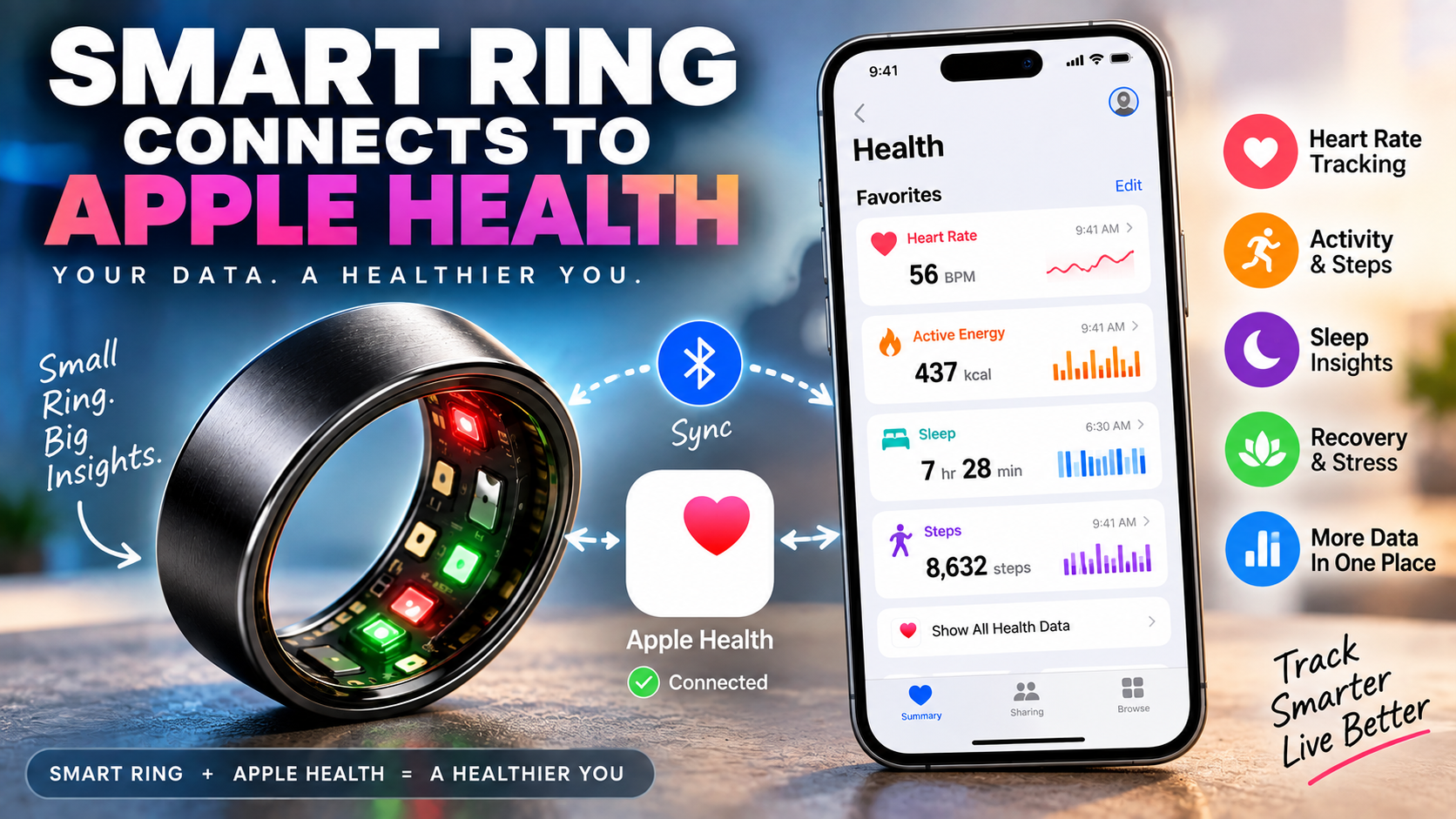
Apple Health
Apple Health can act as a central health-data platform for compatible smart-ring ecosystems. Oura specifically lists Apple Health among its supported integrations.
Android Health Connect
Health Connect can help compatible Android users share health and fitness information between supported applications. Oura lists Health Connect by Android among its third-party integrations.
Samsung Health
Samsung Health is the natural companion platform for Galaxy Ring users. Galaxy Ring continuously synchronizes activity and health data with Samsung Health, where users can review exercise, steps, calories, sleep, and other measurements.
Strava
Strava can complement smart-ring data by providing a dedicated training and activity platform for compatible ecosystems. Oura specifically supports Strava integration for importing activity data.
What Are the Pros and Cons of Using a Smart Ring for Fitness?
Smart rings offer excellent passive tracking and comfort, but they have limitations compared with dedicated fitness watches. Understanding both sides helps you decide whether a ring fits your training style.
Pros of Smart Rings
- Comfortable overnight: Their small, screen-free form makes continuous wear easier.
- Strong recovery tracking: Leading rings combine sleep, activity, and heart-rate information.
- Longer battery life: Many models last several days between charges.
- Distraction-free: No large screen or constant notifications.
- Compact design: Rings are easier to wear discreetly than many wrist devices.
- Passive monitoring: Data collection can continue without constantly interacting with the device.
- Growing ecosystems: Leading brands increasingly connect with health and fitness apps.
Cons of Smart Rings
- Limited workout controls: Most rings cannot match a sports watch for live training features.
- No large display: You generally need a phone to view detailed information.
- Subscription costs: Some premium ecosystems require recurring memberships.
- Fit matters: An incorrect ring size can affect comfort and potentially data quality.
- Less suitable for advanced athletes: Marathoners, cyclists, and triathletes may need dedicated sports hardware.
- Data interpretation varies: Different brands use different algorithms and scoring systems.
How Should You Choose the Right Smart Ring for Your Fitness Goals?
You should choose a smart ring by matching its features to your primary fitness goal, smartphone ecosystem, budget, and willingness to pay recurring fees. A simple decision process can prevent you from paying for features you will rarely use.
Step 1: Define Your Main Fitness Goal
Your primary fitness goal should determine which metrics matter most. For example, a strength-training beginner may care about activity, sleep, and recovery, while a serious runner may prioritize heart rate, GPS, pace, and training load.
Ask yourself:
- Do I primarily want workout tracking?
- Do I care more about sleep and recovery?
- Do I want fitness insights without a subscription?
- Do I already use Samsung Health, Apple Health, Strava, or another ecosystem?
- Will I use a smartwatch alongside the ring?
Step 2: Check Smartphone Compatibility
Smartphone compatibility should be confirmed before purchasing because some rings work best within specific ecosystems. Samsung Galaxy Ring, for example, requires Android 11 or later and Samsung’s supporting apps.
Step 3: Calculate the Total Cost
Total ownership cost includes the ring price, subscription fees, accessories, and potential replacement costs. A $350 ring with a recurring subscription can become more expensive over several years than a slightly cheaper subscription-free model.
For example, Oura’s U.S. membership is $69.99 per year, so the recurring fee should be considered alongside the initial hardware purchase.
Step 4: Prioritize Battery Life
Battery life should match your willingness to charge the ring regularly. If you frequently travel or want uninterrupted sleep tracking, RingConn’s longer claimed battery life may be more attractive.
Step 5: Get the Size Right
Correct sizing is essential because a smart ring needs consistent skin contact without becoming uncomfortable. Oura recommends using the correct sizing kit for Ring 5 because its sizing differs from Ring 4.
Step 6: Don’t Buy a Ring When You Really Need a Sports Watch
A smart ring should not replace a dedicated sports watch if your training requires advanced GPS, navigation, live pace, structured workouts, or extensive on-device controls. Instead, a ring can complement that watch by handling sleep, recovery, and continuous health tracking.
What Are the Most Frequently Asked Questions About Fitness Smart Rings?
What Is the Best Smart Ring for Fitness in 2026?
Oura Ring 5 is the strongest overall choice for fitness users who prioritize activity, recovery, sleep, and health insights. RingConn Gen 2, Samsung Galaxy Ring, and Ultrahuman Ring AIR can be better choices for specific priorities such as no subscription, Samsung integration, or fitness-focused insights.
Which Smart Ring Is Best for Gym Workouts?
Oura Ring 5 is a strong option for gym users because its activity detection and recovery features can complement strength training. However, a smartwatch remains more useful for live workout controls and structured training.
Which Smart Ring Is Best Without a Subscription?
RingConn Gen 2 and Ultrahuman Ring AIR are strong subscription-free choices. Both manufacturers state that users can access core ring data without recurring membership fees.
Are Smart Rings Good for Running?
Smart rings are useful for runners who prioritize recovery, sleep, and daily health tracking, but dedicated running watches remain better for advanced live training. Oura’s Live Activity Tracking can use phone GPS for pace and distance, which makes it more useful for runners than earlier generations.
How Long Does a Fitness Smart Ring Battery Last?
Fitness smart-ring battery life typically ranges from several days to more than 10 days depending on the model and usage. Current examples include Oura Ring 5 at approximately 6–9 days, Galaxy Ring at up to 7 days for certain sizes, RingConn Gen 2 at up to 10–12 days, and RingConn Gen 2 Air at up to 10 days.
Can a Smart Ring Replace a Fitness Tracker?
A smart ring can replace a basic fitness tracker for users who primarily want activity, sleep, recovery, and health monitoring. It is less suitable as a replacement for advanced sports watches that provide detailed GPS and live training controls.
Are Smart Rings Accurate for Heart Rate?
Modern smart rings can provide useful heart-rate measurements, but accuracy depends on the device, activity, fit, and measurement conditions. Oura, for example, reports 99% heart-rate accuracy against ECG in its own Ring 5 testing, while independent studies should also be considered when evaluating accuracy.
Do Smart Rings Track Calories?
Many smart rings estimate calories burned using activity and biometric data. Samsung Galaxy Ring, for example, records calories as part of its activity diagnostics, while other rings provide calorie-related activity metrics through their companion apps.
Can You Wear a Smart Ring While Swimming?
Many leading smart rings are designed for water exposure, but the exact water-resistance rating varies by model. Oura Ring 5 is rated for water resistance up to 100 meters, while RingConn Gen 2 and Gen 2 Air list IP68 and water resistance suitable for swimming.
Is a Smart Ring Better Than an Apple Watch or Garmin?
A smart ring is better for users who prioritize discreet continuous monitoring, while Apple Watch and Garmin devices are generally better for advanced workout interaction and sports tracking. The two categories can complement each other rather than compete directly.
What’s Next? How Do You Choose the Best Smart Ring for Fitness?
The next step is to identify your fitness priorities and shortlist two or three rings that match them before buying. A practical shortlist prevents you from choosing a device based only on popularity or advertising.
Use this checklist:
- Choose your primary goal: fitness, recovery, sleep, running, gym, or general wellness.
- Check compatibility: confirm that the ring works with your iPhone or Android phone.
- Compare subscriptions: calculate the total cost over two or three years.
- Compare workout tracking: check whether the ring supports the activities you actually perform.
- Check recovery features: look for sleep, HRV, resting heart rate, readiness, and related trends.
- Compare battery life: consider how often you are willing to charge.
- Check water resistance: especially if you swim or train outdoors.
- Get the correct size: use the manufacturer’s sizing process rather than guessing.
- Consider the app: the best hardware is not useful if the software is confusing.
- Decide whether you need a sports watch: serious runners and athletes may benefit from using both.
Conclusion: Which Smart Ring Is Best for Fitness?
The best smart ring for fitness is the one that matches your training goals, recovery needs, smartphone ecosystem, budget, and preferred ownership model. There is no single ring that is perfect for every athlete or fitness enthusiast.
Overall, Oura Ring 5 is the strongest choice for users who want a comprehensive combination of fitness, sleep, recovery, and health insights. Its 2026 software updates have also strengthened its workout functionality with improved activity detection and Live Activity Tracking.
Meanwhile, RingConn Gen 2 is particularly compelling for long battery life and subscription-free ownership, while Samsung Galaxy Ring makes the most sense for users deeply invested in Samsung Health. Ultrahuman Ring AIR is another strong subscription-free option for users interested in fitness and recovery insights.
Ultimately, smart rings work best when they help you build better habits rather than simply giving you more numbers to watch. Choose the device whose data you will actually use, wear it consistently, and treat the trends as guidance for improving your training, recovery, sleep, and everyday activity.