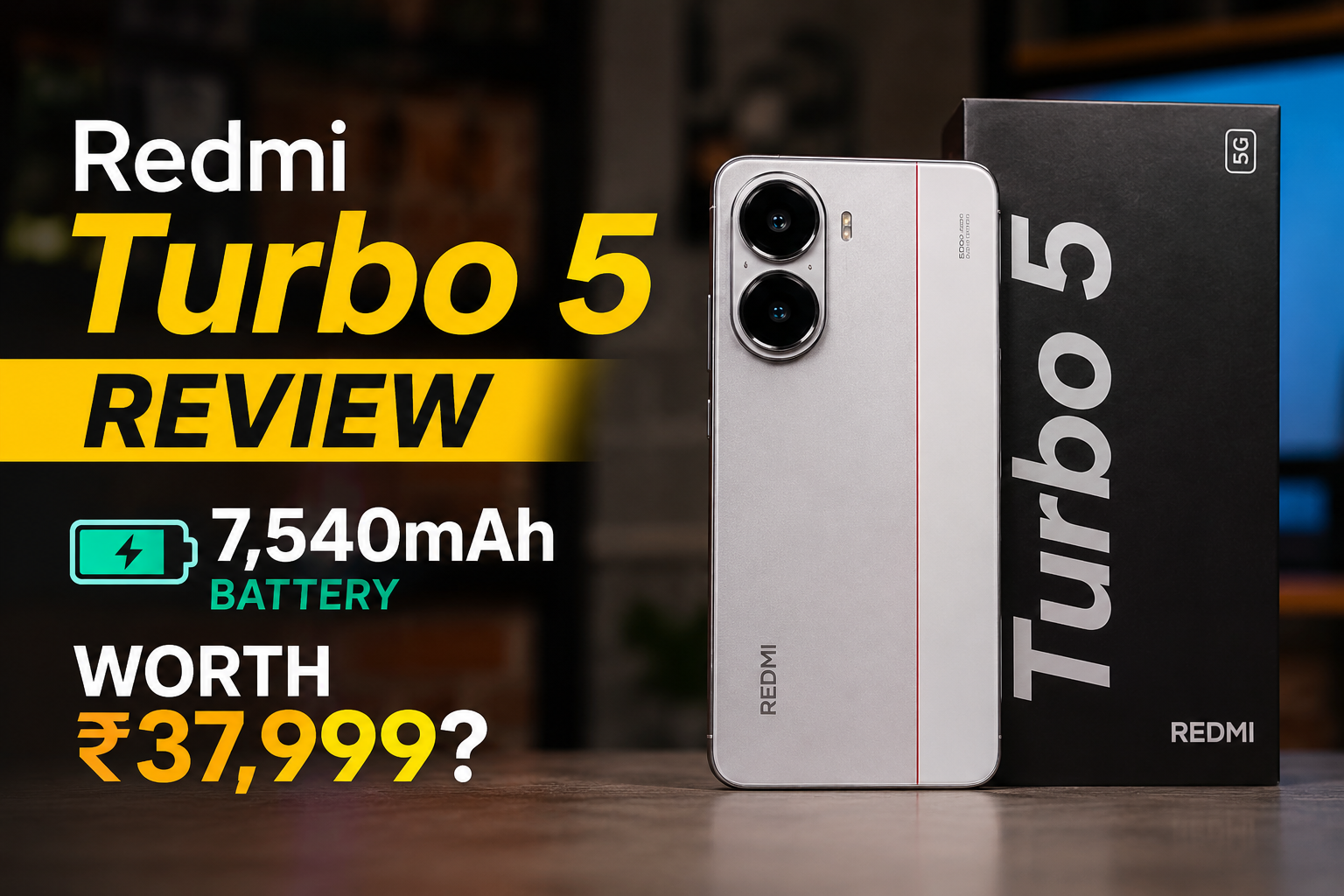
Redmi Turbo 5 Review: Is the 7,540mAh Battery Worth ₹37,999?
Quick Verdict
The Redmi Turbo 5 is the first phone in Redmi's performance-focused Turbo lineup to officially reach India, and it makes its case almost entirely through one number: 7,540mAh. That's the largest battery Redmi has ever shipped, and it's wrapped around a MediaTek Dimensity 8500 Ultra chipset, a 120Hz AMOLED display rated for 3,500 nits, and 100W charging that gets you from empty to full in about 70 minutes. At ₹37,999 (or ₹35,999 with the launch bank offer), it undercuts or matches the OnePlus Nord 6, Motorola Edge 70 Pro, and iQOO Neo 10 while offering a battery that's meaningfully larger than most of them on the spec sheet. The camera is the weak link, and the chipset isn't the fastest in its class on paper, but for someone whose biggest daily frustration is hunting for a charger by 4 PM, this phone solves that problem better than almost anything else under ₹40,000.
How this review was put together: This isn't based on a single press release. The conclusions here draw on the official Xiaomi spec sheet and launch pricing, independent Geekbench and AnTuTu listings collected across multiple test units, and hands-on impressions from Indian tech publications that ran their own gaming, thermal, and charging tests after the phone went on sale on June 19, 2026. Where manufacturer claims and independent measurements disagree — which happens more often than brands like to admit — both numbers are shown so you can see the gap for yourself.
Redmi Turbo 5 Specifications at a Glance
| Specification | Details |
|---|---|
| Display | 6.59-inch 1.5K AMOLED, 1268 x 2756 pixels, 120Hz refresh, up to 3,500 nits peak brightness, Dolby Vision, 480Hz touch sampling |
| Chipset | MediaTek Dimensity 8500 Ultra (4nm, up to 3.4GHz) |
| GPU | Mali-G720 MC8 |
| RAM / Storage | 8GB/12GB LPDDR5X Ultra RAM; 256GB UFS 4.1 storage (variant dependent) |
| Battery | 7,540mAh silicon-carbon cell |
| Charging | 100W wired HyperCharge, 27W wired reverse charging; no wireless charging |
| Rear Camera | 50MP primary with OIS + 8MP secondary sensor |
| Front Camera | 20MP |
| Software | HyperOS 3 on Android 16; 4 years OS updates, 6 years security patches |
| Build | Aluminum frame, glass front, IP68/IP69K rating, 5,300mm² vapour chamber cooling |
| Dimensions / Weight | 157.5 x 75.2 x 8.2mm; 204 grams |
| Connectivity | 5G, Wi-Fi 7, Bluetooth 6.0, IR blaster, in-display fingerprint sensor |
| Colours | Asphalt Black, Nitro Blue, Turbo White |
| Price (India) | ₹37,999 (8GB+256GB) / ₹40,999 (12GB+256GB); effective ₹35,999 / ₹38,999 with bank offer |
Price in India: Variants, Launch Offers, and What You'll Actually Pay
Here's where the marketing gets a little confusing if you're not paying attention. The official MRP for the Redmi Turbo 5 is ₹37,999 for the 8GB+256GB variant and ₹40,999 for the 12GB+256GB variant. But Xiaomi is running a ₹2,000 instant discount with select SBI, ICICI, and Axis Bank cards through the launch period, which brings the effective price down to ₹35,999 and ₹38,999 respectively. Most marketing material you'll see — including Xiaomi's own social posts — leads with the discounted figure, so don't be surprised if you see both ₹35,999 and ₹37,999 floating around for what is technically the same SKU.
The phone went on sale on June 19, 2026 through Amazon.in, Xiaomi's own Mi.com store, and select offline retail partners. If you're shopping outside the bank-offer window, budget for the full ₹37,999, since that discount is explicitly tied to specific cards and a limited sale period, not a permanent price cut.
One practical note: at this exact price point, you're competing directly with last year's flagship leftovers and this year's upper-mid-range crop, so it's worth checking whether a slightly older flagship on discount might out-perform this on raw chipset power if camera and brand polish matter more to you than battery size.
Should You Wait for a Price Drop?
Brand-new Xiaomi launches in India almost always see a second round of discounting once the initial 4-6 week sales push settles down, typically through festive sale events or a fresh bank-offer cycle. If you're not in a rush, watching for an Amazon or Flipkart sale event a month or two post-launch has historically shaved a few thousand rupees off similar Redmi and Poco launches. That said, if you need a phone right now and the effective ₹35,999 bank-discount price is available to you, it's already a fair launch price relative to what the Nord 6 and Edge 70 Pro are charging for similar hardware — waiting purely to save a small amount isn't always worth the opportunity cost of using an old, dying battery for two more months.
Design and Build Quality
Redmi clearly had to make a trade-off to fit a 7,540mAh cell into a phone that doesn't feel like a brick, and the result is reasonably well managed. At 8.2mm thick and 204 grams, it's noticeably heavier than typical 180-190 gram phones in this class, but it doesn't feel unbalanced — the weight is distributed evenly rather than concentrated near the camera module the way some big-battery phones end up feeling top-heavy.
The standout here is the IP68/IP69K rating, which is unusual at this price. IP69K specifically means the phone can survive high-pressure, high-temperature water jets — a rating you'd normally expect on industrial equipment, not a ₹38,000 smartphone. Xiaomi is also using this to market the phone toward delivery riders, fieldwork users, and anyone who's nervous about monsoon commutes. The aluminum frame and glass front feel appropriately premium for the segment, and the RGB lighting ring around the camera module (Redmi calls it "Pixel Matrix") is a small but genuinely fun touch for notifications and charging status — though it's the kind of feature you'll either love showing off or turn off within a week.
Available colourways are Asphalt Black, Nitro Blue, and Turbo White. None of them are particularly daring, but the matte finishes on the black and blue variants resist fingerprints noticeably better than glossy alternatives in this price band.
Display: 6.59-inch 1.5K AMOLED in Daily Use
The display is genuinely one of the stronger parts of this phone and doesn't get talked about enough next to the battery headline. You're getting a 6.59-inch AMOLED panel at 1268 x 2756 resolution (so, true 1.5K, not just marketing rounding), a 120Hz refresh rate, and Dolby Vision support for compatible streaming content. The peak brightness claim of 3,500 nits is the number that matters most practically — that's high enough to keep the screen legible in direct Indian summer sunlight, which is where a lot of cheaper AMOLED panels start to wash out.
Touch responsiveness is also higher-end than you'd expect: 480Hz touch sampling normally, jumping to an instant 2,560Hz sampling rate during gaming sessions. In practice, this means tap-to-fire and swipe-aim inputs in competitive shooters register with less perceptible lag than on phones using standard 240-360Hz touch sampling.
If there's a nitpick, it's that Xiaomi hasn't confirmed which specific Gorilla Glass variant protects the display, which is a detail enthusiast buyers will want before deciding whether a case is mandatory. Given the IP69K rating elsewhere on the phone, this feels like an oversight in the spec sheet rather than a corner being cut, but it's worth checking current listings for an update.
Performance: How the Dimensity 8500 Ultra Actually Holds Up
Benchmark Numbers
On paper, the Dimensity 8500 Ultra isn't chasing the absolute top of the charts. Independent Geekbench 6 listings put it around 1,659-1,729 on single-core and roughly 6,686-6,764 on multi-core, with GPU testing landing near 13,154 points. Xiaomi's own marketing claims AnTuTu scores above 2.3 million, though aggregated real-world listings across multiple test units average closer to 1.78 million — a gap that's fairly typical between manufacturer-claimed peak numbers and what independent reviewers measure across several units under normal thermal conditions.
What that translates to: this chip sits comfortably in upper-mid-range territory. It's not going to outscore a Snapdragon 8 Gen 3-class flagship, but it's a clear step up from budget Dimensity or Snapdragon 6-series silicon, and it's roughly on par with what you'd expect from a phone priced ₹3,000-5,000 higher.
Gaming and Thermal Behaviour
This is where the Turbo branding actually earns its keep. Reviewers running extended BGMI and CoD Mobile sessions with Wild Boost enabled report consistent 120fps gameplay, which is the kind of claim that sounds good in a press release but doesn't always hold up after 30 minutes — except in this case, it largely did during testing.
Thermals are a mixed picture. During a 40-minute combined BGMI and CoD Mobile session, one reviewer measured a 14°C surface temperature increase on the Redmi Turbo 5 — lower than the Motorola Edge 70 Pro (also running a Dimensity 8500-class chip) but slightly behind the OnePlus Nord 6 in sustained thermal efficiency. Where the Turbo 5 pulled ahead was in a dedicated burnout/CPU throttling test, where it held peak performance slightly longer than the Nord 6 before throttling kicked in. In plain terms: it gets warm, not uncomfortably hot, and it's tuned to resist performance drop-off during long sessions better than its thermal numbers alone would suggest.
The 5,300mm² vapour chamber is doing real work here — it's a notably large cooling system for a phone in this price bracket, and it's the main reason sustained performance holds up as well as it does despite the chip not being the newest or fastest silicon available.
The 7,540mAh Battery: Is It Actually a Two-Day Phone?
This is the question everyone's actually asking, so let's be direct about it. A 7,540mAh battery is genuinely large — for context, most phones in the ₹35,000-40,000 range carry somewhere between 5,500mAh and 6,500mAh, so this is roughly 15-35% more capacity than typical competitors, not just a marginal bump.
Whether that becomes a literal "two-day phone" depends entirely on what you're doing with it. For moderate use — messaging, social media, an hour of video, some browsing — stretching to a day and a half or close to two days is realistic. For someone gaming for an hour or more daily at high brightness with 120Hz enabled throughout, you're looking at strong all-day battery life with comfortable margin, rather than a guaranteed two-day result. Xiaomi's own "two-day phone" marketing language is best read as the upper-bound, best-case scenario rather than a typical day for a heavy user.
Where this battery genuinely changes the ownership experience is charging frequency and charging speed together. The 100W wired charging is rated to take the phone from flat to full in roughly 70 minutes, according to Xiaomi's own testing — and because the battery itself is so much larger, you simply need to plug in less often even with a similar charging speed to competitors. There's also 27W wired reverse charging, letting you top up another device (earbuds, a smartwatch, even a friend's phone) directly from the Turbo 5 — useful in a pinch, though it's not something most people will use regularly.
The one omission worth flagging: there's no wireless charging at all. If you've gotten used to dropping your phone on a charging pad overnight, that habit doesn't carry over here, and it's a fair trade-off question against the larger battery for some buyers.
What "Silicon-Carbon Battery" Actually Means
You'll see "silicon-carbon" mentioned a lot in the Turbo 5's marketing, and it's worth unpacking briefly because it's not just a buzzword. Traditional lithium-ion batteries use a graphite anode, which has a practical energy-density ceiling. Silicon-carbon battery chemistry blends silicon into that anode structure, which allows the cell to store noticeably more energy in roughly the same physical volume — it's the same underlying shift that let several 2025-2026 phones suddenly jump from 5,000mAh-class batteries to 7,000-9,000mAh-class batteries without the phone turning into a brick.
The trade-off historically associated with silicon-carbon cells has been slightly faster degradation over hundreds of charge cycles compared to pure graphite cells, though battery management software (HyperOS 3 includes adaptive charging and battery health throttling features) has gotten significantly better at mitigating this. If you plan to keep the phone for 3+ years, it's worth using the battery health optimisation settings from day one rather than ignoring them.
RAM, Storage, and Variant Choice: Which One Should You Pick
The Redmi Turbo 5 comes in two configurations in India: 8GB RAM with 256GB storage, and 12GB RAM with 256GB storage, both running fast LPDDR5X Ultra RAM and UFS 4.1 storage. There's no storage expansion via microSD, which is fairly standard at this price now but still worth knowing before you buy if you shoot a lot of 4K video.
For most buyers, the 8GB variant is genuinely enough. HyperOS 3 manages background apps efficiently, and unless you're someone who keeps fifteen heavy apps suspended in memory at once or you're planning to keep this phone for three-plus years and want extra headroom against future software bloat, the ₹3,000 jump to 12GB doesn't buy you a noticeably different day-to-day experience. Where the extra RAM does help slightly is in keeping games like BGMI cached in memory longer during multitasking-heavy sessions — useful if you frequently switch between a game and messaging apps mid-match.
UFS 4.1 storage is a genuine upgrade over the UFS 3.1 you'll find on some competitors at this price, translating into faster app load times and quicker large-file transfers, even though most users won't consciously notice the difference outside of benchmark apps.
Network, Connectivity, and Call Quality
The Redmi Turbo 5 covers the connectivity basics well for 2026: 5G across the relevant Indian bands, Wi-Fi 7 support (genuinely future-facing, since most home routers in India still haven't caught up to it), and Bluetooth 6.0. An IR blaster is included too, which sounds like a small thing until you're using your phone as a universal remote for your TV and AC during a power cut and a dead remote.
Call quality during testing has been reported as clear on both ends, with no notable network drop issues during the review period — though as always with a newly launched phone, it's worth checking for any carrier-specific firmware updates in the weeks following launch, since early software builds occasionally need a patch or two to fully stabilise network behaviour across all telecom operators.
Audio and Multimedia Experience
Stereo speakers are present, and they get loud enough for casual video watching or hands-free calls without obvious distortion at higher volumes, though — as with most phones in this segment — bass response is thin and you'll still want headphones or a Bluetooth speaker for serious music listening. Dolby Vision support on the display is the more meaningful win here for multimedia: Netflix, Prime Video, and other Dolby Vision-enabled content on supported apps render with noticeably better contrast and colour depth than on a standard AMOLED panel without that certification.
Combined with the 120Hz refresh rate and high peak brightness, this makes the Turbo 5 a genuinely strong choice for someone who watches a lot of content on their phone during commutes or before bed, not just for gamers.
What Independent Reviewers Are Saying
Early reviews from Indian tech publications have been fairly consistent in their conclusions. Most agree the phone delivers on its core promise — strong battery life and dependable sustained gaming performance — while flagging the same two limitations repeatedly: camera versatility and the absence of wireless charging. Reviewers running side-by-side thermal and benchmark comparisons against the Motorola Edge 70 Pro and OnePlus Nord 6 have generally placed the Turbo 5 ahead on raw battery capacity-to-price ratio and sustained throttling resistance, while ranking it behind the Nord 6 specifically on peak thermal efficiency and behind the Edge 70 Pro on camera flexibility.
None of the early coverage has flagged major software bugs or hardware defects at launch, which is reassuring for a first-generation India launch of a previously China-only series — Redmi clearly spent real engineering time adapting this for the Indian market rather than doing a rushed rebrand.
Camera Performance
Nobody is buying the Redmi Turbo 5 for its camera, and Redmi isn't really pretending otherwise. The setup is a 50MP primary sensor with optical image stabilisation, paired with an 8MP secondary lens, and a 20MP front camera for selfies and video calls.
In daylight, the primary sensor produces sharp, accurately coloured shots that hold up fine for social posting and everyday documentation. Low-light performance benefits from OIS and computational processing that reduces grain and balances exposure better than you'd expect from a single capable sensor doing most of the work — there's a dedicated night mode that handles ambient-light scenes reasonably well.
The honest limitation is versatility. There's no dedicated ultrawide lens and no telephoto/periscope zoom, so you're working almost entirely with the main sensor and digital crop for anything beyond standard framing. Competing phones in this exact price bracket — particularly camera-focused options like the Motorola Edge 70 Pro+ in the segment above this — clearly outperform it here. If photography variety matters more to you than raw endurance or performance, this isn't the phone built for that priority.
Software and Update Policy: HyperOS 3
The Redmi Turbo 5 ships on HyperOS 3, built on Android 16. Out of the box, bloatware is relatively contained and most of what's preinstalled can be uninstalled cleanly, which hasn't always been true of Xiaomi software historically. Gaming-specific features like Game Turbo (for performance profile switching and do-not-disturb during matches) and a dedicated Reading Mode for extended screen time are useful additions rather than gimmicks.
The update commitment — 4 years of Android OS upgrades and 6 years of security patches — is genuinely competitive for this price segment. It roughly matches or slightly trails what OnePlus is offering on the Nord 6, and it comfortably beats what most sub-₹40,000 Android phones historically promised just two or three years ago. If long-term software support matters to your buying decision, this is one of the stronger commitments at this price.
Redmi Turbo 5 vs OnePlus Nord 6 vs Motorola Edge 70 Pro
These three phones are essentially fighting over the same buyer right now, so a direct comparison matters more here than in most reviews.
| Spec | Redmi Turbo 5 | OnePlus Nord 6 | Motorola Edge 70 Pro |
|---|---|---|---|
| Price (starting) | ₹37,999 (₹35,999 effective) | ₹38,999 | ₹38,999 |
| Chipset | Dimensity 8500 Ultra | Snapdragon 8s Gen 4 | Dimensity 8500 Extreme |
| Battery | 7,540mAh | Up to 9,000mAh (India variant) | 6,500mAh |
| Charging | 100W wired | 80W wired, bypass charging | 90W wired |
| Refresh Rate | 120Hz AMOLED | 120Hz+ AMOLED | 144Hz AMOLED ("Extreme") |
| Software Updates | 4 yrs OS / 6 yrs security | 4 yrs OS / 6 yrs security | 3 yrs OS / 5 yrs security |
| Standout Strength | Sustained gaming + IP69K durability | Largest battery, OxygenOS polish | Camera versatility, near-stock Android |
The honest takeaway: if pure battery capacity is your single deciding factor, the Nord 6's India-spec battery edges out the Turbo 5 on paper. If you care more about sustained gaming performance and ruggedness (that IP69K rating), the Turbo 5 pulls ahead. If cameras and a clean software experience are the priority, the Edge 70 Pro is the better fit of the three, accepting a smaller battery in return.
Wider Competitor Check: iQOO Neo 10 and POCO X8 Pro Max
The Nord 6 and Edge 70 Pro aren't the only phones gunning for this buyer. Two more names deserve a spot in this comparison, even though they sit at slightly different price points.
The iQOO Neo 10 actually undercuts the Turbo 5 on price in some configurations, starting around ₹36,999-39,999 depending on RAM and storage. It runs a Qualcomm Snapdragon 8s Gen 4 instead of a MediaTek chip, pairs it with a 7,000mAh battery and 120W charging (genuinely faster top-up than the Turbo 5's 100W), and adds a sharper 144Hz refresh rate on its 6.78-inch AMOLED display. Where it falls behind is durability — the Neo 10 carries only an IP65 rating, nowhere near the Turbo 5's IP68/IP69K certification, which matters if you're buying this as a rough-and-tumble daily driver rather than a careful desk companion.
The POCO X8 Pro Max plays in a different league entirely on battery, packing a 9,000mAh (with some listings citing 8,500mAh) cell alongside a more powerful Dimensity 9500s chipset, a larger 6.83-inch 1.5K AMOLED panel, and full IP66/IP68/IP69/IP69K-rated durability. It's also a genuinely faster chip than the Turbo 5's Dimensity 8500 Ultra. The catch is price — at ₹42,999-44,999, it sits a full price tier above the Turbo 5, so it's less a head-to-head rival and more a "spend ₹5,000-7,000 more and get Xiaomi's actual flagship-battery phone" option for buyers who can stretch their budget.
| Spec | Redmi Turbo 5 | iQOO Neo 10 | POCO X8 Pro Max |
|---|---|---|---|
| Price (starting) | ₹37,999 (₹35,999 effective) | ₹36,999-39,999 | ₹42,999-44,999 |
| Chipset | Dimensity 8500 Ultra | Snapdragon 8s Gen 4 | Dimensity 9500s |
| Battery | 7,540mAh | 7,000mAh | ~9,000mAh |
| Charging | 100W wired | 120W wired | 100W wired |
| Display | 6.59-inch 120Hz AMOLED | 6.78-inch 144Hz AMOLED | 6.83-inch 1.5K AMOLED |
| Durability Rating | IP68/IP69K | IP65 | IP66/IP68/IP69/IP69K |
| Standout Strength | Balanced price-to-durability ratio | Fastest charging, sharpest refresh rate | Biggest battery, strongest chipset |
Stacking all four rivals together, the pattern that emerges is fairly clear: the Redmi Turbo 5 isn't the single best phone in any one category against this full field, but it's the only one that doesn't make you sacrifice something major to get it. The Neo 10 trades durability for speed, the Nord 6 trades brand polish for battery, the Edge 70 Pro trades battery for cameras, and the X8 Pro Max simply costs more to get genuinely more. If you want the most "no major weakness" phone at exactly ₹38,000, the Turbo 5 is arguably the safest pick of the five.
Pros and Cons
| Pros | Cons |
|---|---|
| Massive 7,540mAh battery with fast 100W charging | No wireless charging at all |
| Strong sustained gaming performance, large vapour chamber cooling | Camera versatility is limited — no ultrawide or zoom lens |
| IP68/IP69K rating is unusually robust for this price | Runs warmer than the OnePlus Nord 6 under extended gaming load |
| 3,500-nit peak brightness AMOLED display is excellent outdoors | Chipset isn't the fastest in its price segment on raw benchmark scores |
| Solid 4-year OS / 6-year security update commitment | Not officially available in Bangladesh or Nepal yet |
Common Buying Mistakes to Avoid
- Assuming the discounted price is permanent. The ₹35,999 figure depends on a limited-period bank card offer. Confirm the current price and offer terms before you commit, especially if you're buying weeks after launch.
- Buying it purely for gaming benchmarks. The Dimensity 8500 Ultra is a solid sustained performer, not a chart-topper. If raw peak gaming power is your only priority, compare current AnTuTu/Geekbench numbers against a Snapdragon 8-series device before deciding.
- Expecting flagship-level photography. This is a performance-and-battery phone first. If your phone is primarily your camera, this isn't the right pick, even at this price.
- Importing it into Bangladesh expecting official warranty support. Without an official Xiaomi Bangladesh launch, you're buying through grey-market importers, which usually means no manufacturer warranty and inflated pricing.
- Ignoring the weight and thickness if you have small hands or use one-handed often. At 204 grams and 8.2mm, this is noticeably chunkier than slimmer rivals — worth a quick in-hand check before buying online.
Who Should Buy the Redmi Turbo 5 (and Who Shouldn't)
This phone makes the most sense for mobile gamers who play in long sessions and are tired of charging mid-day, delivery and field workers who need genuine water/dust resistance, and anyone upgrading from a phone where "low battery anxiety" was a daily annoyance. It also suits buyers who want a long software support window without paying flagship prices.
It makes less sense for photography-first buyers, anyone who relies on wireless charging as part of their daily routine, or buyers who specifically want the absolute fastest chipset available at this price point rather than the best-tuned one for sustained performance.
Redmi Turbo 5 Availability in Bangladesh and Nepal
A lot of search interest around this phone comes from Bangladesh, and it's worth being upfront here: there's no confirmed official Xiaomi Bangladesh launch for the Redmi Turbo 5 as of this writing. The phone is available through unofficial importers in the Bangladeshi market, with prices varying fairly widely — commonly somewhere in the BDT 43,000-48,000 range depending on the retailer and whether it's a newer or older import batch. Since these are grey-market units, official Xiaomi warranty support typically doesn't apply, and pricing can shift without much notice.
Nepal is in a similar position — no confirmed official launch yet, though informal price estimates have circulated based on currency conversion from the Indian price. If you're in either market and want official warranty backing, it's worth waiting for a confirmed regional launch rather than buying an import unit, unless you're comfortable with the trade-offs that come with grey-market purchases.
Industry Insight: Why the "Turbo" Branding Matters Here
Redmi's Turbo series has existed in China for a while, positioned as a performance-first line that sits above the Note series but below true flagships — essentially Redmi's answer to brands like iQOO's Neo line or Poco's X-series, which chase gamers and power users specifically rather than trying to be all-rounders. Bringing it to India officially (rather than as a China-only curiosity some buyers import anyway) signals that Xiaomi sees enough demand in this exact segment — big battery, strong sustained performance, durability — to justify a dedicated sub-brand line rather than just folding these features into the Note series.
That's a useful lens for understanding the camera trade-off too. This isn't an oversight; it's a deliberate positioning choice. Redmi is betting that a meaningful chunk of buyers in this price range would rather have battery and performance headroom than another mediocre ultrawide lens they'll rarely use.
Frequently Asked Questions
Is the Redmi Turbo 5 worth buying at ₹37,999?
For battery life and sustained gaming performance specifically, yes — it offers more battery capacity and better thermal-sustained performance than most phones at this price. If camera quality or the absolute fastest chipset matters more to you, it's worth comparing directly against the Nord 6 or Edge 70 Pro first.
Does the Redmi Turbo 5 support wireless charging?
No. It supports 100W wired charging and 27W wired reverse charging, but there's no wireless charging coil included.
How long does the Redmi Turbo 5 battery actually last?
For moderate daily use, a day and a half to close to two days is realistic. Heavy gaming and high-brightness use will bring that down to strong all-day battery life rather than a guaranteed two full days.
Is the Redmi Turbo 5 good for gaming?
Yes — independent testing shows consistent 120fps performance in titles like BGMI and CoD Mobile with Wild Boost enabled, backed by a large 5,300mm² vapour chamber cooling system.
Is the Redmi Turbo 5 better than the iQOO Neo 10?
It depends on what you weigh more heavily. The Neo 10 charges faster (120W vs 100W) and has a sharper 144Hz display, but the Turbo 5's IP68/IP69K rating is far more robust than the Neo 10's IP65 rating, making the Turbo 5 the safer pick for anyone who's rough on their phone.
Is the Redmi Turbo 5 available in Bangladesh?
Not officially yet. It's currently sold there only through unofficial importers at varying, typically marked-up prices, without standard manufacturer warranty coverage.
Conclusion
The Redmi Turbo 5 doesn't try to be the best phone under ₹40,000 at everything — it's clearly engineered around one priority, and it executes that priority well. A 7,540mAh battery paired with 100W charging and a chipset tuned for sustained rather than peak performance makes this one of the strongest picks specifically for gamers, heavy daily users, and anyone who's simply tired of carrying a power bank everywhere.
Against the OnePlus Nord 6, Motorola Edge 70 Pro, iQOO Neo 10, and POCO X8 Pro Max, it doesn't win every category — the Nord 6 and X8 Pro Max both pack bigger batteries on paper, the Edge 70 Pro's cameras are more versatile, and the Neo 10 charges faster — but it carves out a clear identity rather than trying to be a slightly-worse version of any one rival. At an effective ₹35,999-37,999, that focused, no-major-weakness approach is exactly what makes it worth considering.
Comments (0)
No comments yet. Be the first to share your thoughts!
Leave a Comment